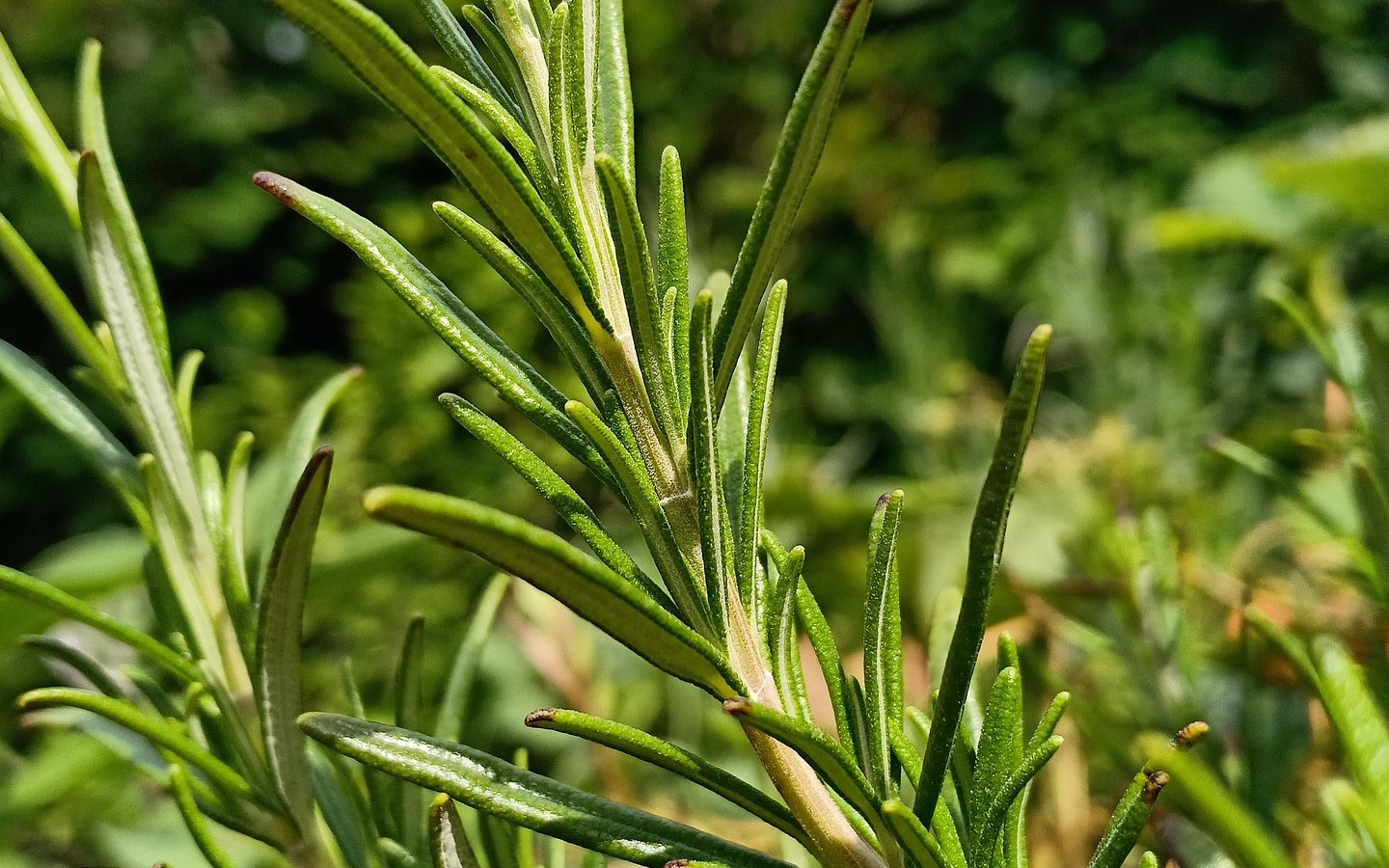
No other common culinary herb carries quite so consistent a reputation across so many centuries and cultures as rosemary’s association with memory. That reputation turns out to have travelled from ancient superstition into a genuine, if modest, line of modern research, which makes rosemary’s history considerably more interesting than a simple list of old wives’ tales.
Rosmarinus officinalis, now more often classified as Salvia rosmarinus, is native to the rocky, sun-baked coastlines of the Mediterranean, and its relationship with the people living around that sea stretches back long before anyone wrote it down. The name itself is generally understood to derive from the Latin ros marinus, dew of the sea, a reference to the plant’s ability to thrive on exposed coastal cliffs with little more than sea spray and rocky soil, and the etymology alone tells us something about how deeply this was a plant of place, tied specifically to the Mediterranean landscape rather than an import from anywhere more exotic.
The herb of remembrance
Rosemary’s association with memory is old enough that its origins are genuinely difficult to pin down with certainty. A frequently repeated story holds that ancient Greek students wore garlands of rosemary while studying, or placed sprigs of it in their hair, in the belief that it would sharpen memory and concentration before examinations. The story is charming and widely told, but it belongs more properly to enduring popular tradition than to a single, verifiable historical source, and it should be enjoyed as folklore rather than cited as settled classical history.
What is considerably better documented is how thoroughly that association had embedded itself into English and European culture by the time William Shakespeare was writing. In Hamlet, Ophelia hands out flowers with pointed symbolic meaning, and rosemary is the first: “There’s rosemary, that’s for remembrance; pray you, love, remember.” By the early seventeenth century, an English audience did not need that symbolism explained to them. Rosemary meant memory, and everybody in the theatre already knew it.
Weddings, funerals, and everything in between
That same association carried rosemary into two of life’s most significant occasions at once. Across large parts of early modern Europe, rosemary sprigs were carried by wedding guests as a token of fidelity and remembrance, and dipped in the celebratory wine, while the same plant, gilded or simply as it grew, was carried at funerals and sometimes thrown into the grave, a gesture of remembering the dead. It is a genuinely unusual position for a single plant to occupy, present at both the happiest and the saddest occasions in a community’s life, unified by the one idea it had come to represent in both settings.
Hungary Water and the birth of modern perfumery
Rosemary also occupies a significant, if partly legendary, place in the history of perfumery. Hungary Water, generally dated to somewhere around the fourteenth century, is often described as one of the earliest alcohol-based perfumed preparations in European history, made principally from rosemary distilled with alcohol. Popular legend attributes its creation to a queen of Hungary, said to have been cured of infirmity by its use in old age, though the historical evidence for that specific royal origin story is thin, and the tale has been retold and embellished for centuries in ways that make the original facts difficult to separate from the legend built on top of them. What is not in dispute is the preparation’s genuine historical importance: it represents an early, documented step in the development of alcohol-based fragrance, a technology that would eventually give rise to the entire modern perfume industry, with rosemary sitting at its origin.
When the folklore met the laboratory
Rosemary’s centuries-old reputation for memory eventually attracted the attention of modern researchers, curious whether there was anything behind it beyond persistent repetition. The results have been genuinely more encouraging than for most botanical folklore of comparable age. Studies investigating rosemary aroma exposure, generally through simple ambient diffusion rather than any topical or oral preparation, have reported associations with improved performance on certain cognitive tasks and altered mood in controlled settings, and rosemary’s active constituents, including 1,8-cineole, have plausible pharmacological mechanisms relevant to cognitive function currently under investigation. This remains an active, evolving area of research rather than a settled conclusion, and it would be a mistake to claim that ancient Greek students were secretly performing sound cognitive science. But it is a rare and genuinely interesting case of centuries-old folklore pointing, however imprecisely, towards a real avenue of modern scientific inquiry.
A herb that never really left
Unlike some botanicals in this Library that disappeared from ordinary use for centuries before a modern rediscovery, rosemary never really left. It has remained in continuous cultivation and use, in Mediterranean kitchens, in European gardens, and eventually far beyond both, more or less without interruption, from the ancient world to the present day. That continuity is itself worth noting: rosemary’s long relationship with memory has survived not because of a single dramatic rediscovery, but because generation after generation simply kept growing it, cooking with it, and, evidently, believing in it, on a kitchen windowsill or a rocky Mediterranean hillside, largely unbroken the entire time.
From the archive to the kitchen and the wash basin
Botanical Rituals · No. 007
The Twice-Weekly Hair Oil
Rosemary’s other well-documented modern reputation: real trial evidence for hair, alongside a personal twice-weekly ritual.
Botanicals Kitchen
Rosemary Focaccia
Rosemary pushed deep into a slow-fermented dough, where the oven draws out its aroma far more effectively than any garnish.
Journal · The Study
Rosemary and the Brain
The folklore ends here. What the modern aroma studies actually measured, the proposed mechanism, and an honest look at the perimenopause question.
Botanical Library · Monograph No. 007
Rosemary
The full monograph: chemistry, chemotypes, the hair-growth trial against minoxidil, safety and cultivation, fully referenced.
References and further reading
- Royal Botanic Gardens, Kew. Plants of the World Online: Salvia rosmarinus Schleid. POWO taxon record
- Shakespeare, W. Hamlet, Act 4, Scene 5.
- Moss, M., Cook, J., Wesnes, K. & Duckett, P. (2003). Aromas of rosemary and lavender essential oils differentially affect cognition and mood in healthy adults. International Journal of Neuroscience, 113(1), 15-38. doi:10.1080/00207450390161903