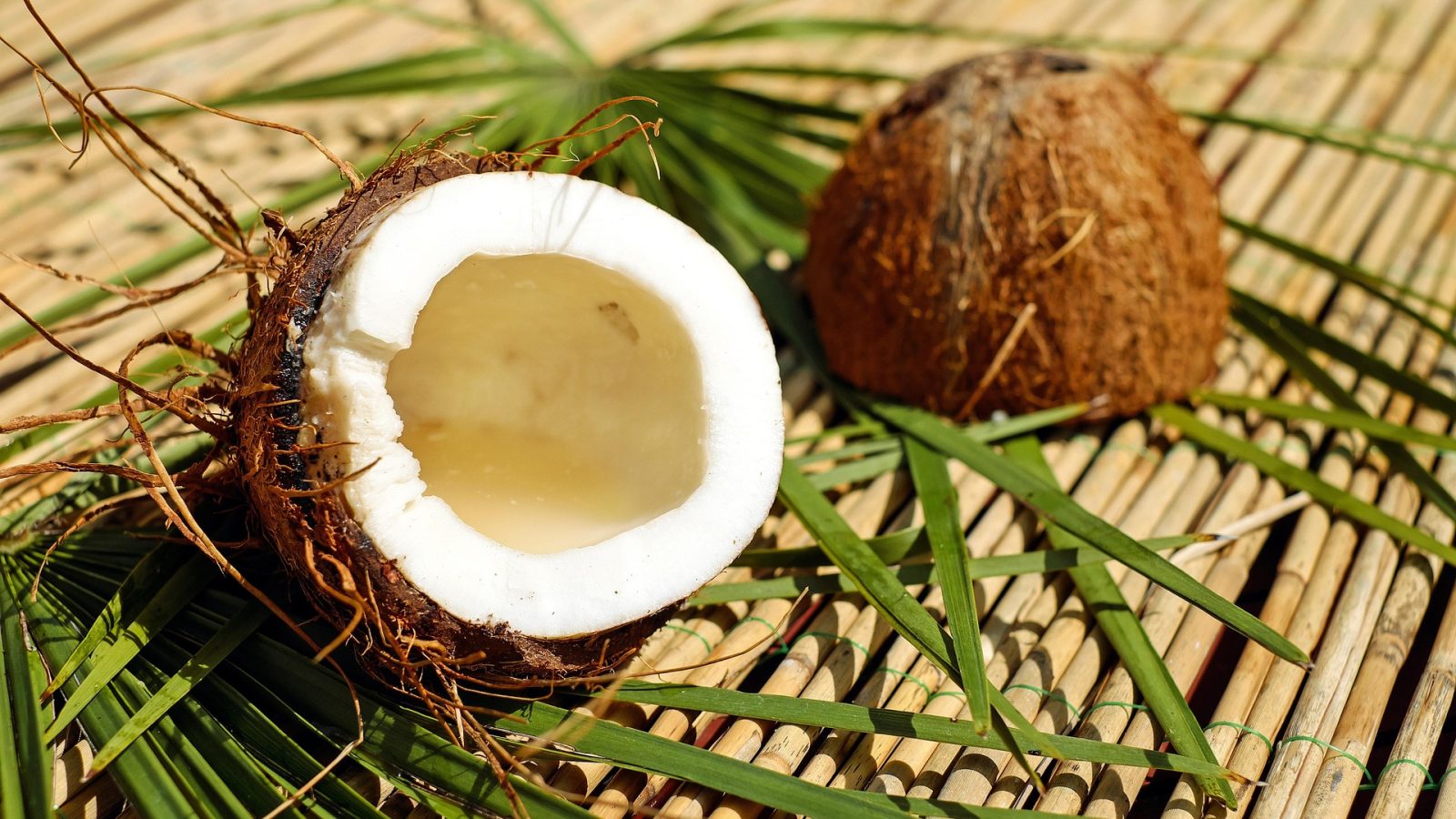
Few ingredients in this Library have swung as dramatically between reputations as coconut oil, examined in full in our Botanical Archives: sacred and indispensable across an enormous stretch of the world for millennia, vilified by Western nutrition science for decades, rehabilitated into a wellness-culture superfood, and now the subject of renewed, more sober scientific attention. This monograph sets that history to one side and looks specifically at what the evidence actually shows for cosmetic and topical use, which is considerably more specific, and in places more genuinely impressive, than either the villain or the superfood story alone suggests.
At a glance
| Botanical name | Cocos nucifera L. |
|---|---|
| Common names | Coconut oil, copra oil |
| Family | Arecaceae (palm family) |
| Native range | Uncertain; widely distributed across the tropical Indo-Pacific well before written record |
| Plant type | Large, single-stemmed palm tree |
| Principal part used | Dried or fresh endosperm (the coconut “meat”) |
| Main ingredient forms | Virgin (cold-pressed), refined/RBD, fractionated (MCT oil) |
| Principal constituents | Lauric acid (~46-50%), myristic acid (~18%), palmitic, caprylic and capric acids; roughly 90% saturated fat overall |
| Traditional uses | Culinary staple, traditional skin and hair care, oral hygiene, across the Pacific, South and Southeast Asia |
| Evidence position | Genuine randomised trial evidence for hair, skin barrier and eczema; dietary saturated-fat caution stands separately and does not contradict the topical evidence |
| Principal safety consideration | Relatively high comedogenic rating; well tolerated on body and hair, more likely to contribute to congestion on acne-prone facial skin |
| Botanical Library | Monograph No. 008 |
One ingredient, three separate reputations
Coconut oil’s history, told in full in our Botanical Archives, moves from tree of life to colonial commodity to mid-century dietary villain to twenty-first-century superfood to renewed scientific caution, all attached to essentially the same jar of fat. What rarely gets told alongside that history is the topical evidence specifically, which has stayed considerably more stable throughout than coconut oil’s dietary reputation, and is the actual subject of this monograph.
Botanical identity
Cocos nucifera belongs to Arecaceae, the palm family, and is a large, single-stemmed tree capable of reaching 30 metres, topped with a crown of large pinnate fronds and bearing its fruit, technically a fibrous drupe rather than a true nut, in bunches. Its precise native range is genuinely uncertain, since coconuts can float and remain viable in seawater for months, allowing the species to disperse across tropical coastlines by ocean current alone well before people became involved, a genuine head start later extended enormously by deliberate human cultivation and transport. Coconut oil itself is pressed or extracted from the endosperm, the white flesh lining the inside of the fruit, either fresh, for virgin oil, or dried first into copra, the traditional basis of the commercial oil trade.
History and traditional uses
Across enormous stretches of the Pacific, Southeast Asia and South Asia, the coconut palm earned the epithet tree of life, or its local equivalent, reflecting genuine, comprehensive dependence: food, drink, fibre, building material and fuel from a single, easily transported nut. Coconut oil specifically became central to cooking, skin and hair care, and traditional medicine across this entire region, in continuous use for centuries before any of it was written down. That history, including the colonial copra trade that later turned it into a global commodity and the mid-century Western “tropical oils scare” that briefly made it a dietary pariah, is covered in full in our Botanical Archives.
Ingredient forms
What a formulator or cook actually receives as “coconut oil” varies considerably by processing, and, unusually for a botanical in this Library, the differences matter more for texture and stability than for the underlying evidence, since the fatty acid profile most relevant to the trials described below is broadly similar across virgin and refined forms.
Virgin coconut oil. Extracted from fresh (not dried) coconut meat without high heat or chemical processing, retaining more of the minor antioxidant compounds present in the raw material alongside coconut’s characteristic aroma. This is the form used in the majority of the clinical trials described below.
Refined (RBD) coconut oil. Produced from dried copra and put through a refining, bleaching and deodorising process, yielding a neutral-smelling, longer-shelf-life oil with a higher smoke point, at the cost of losing most of virgin oil’s minor aromatic and antioxidant compounds.
Fractionated coconut oil (MCT oil). A processed fraction in which most of the longer-chain fatty acids, principally lauric and myristic acid, have been removed, leaving a lighter, odourless liquid oil rich in caprylic and capric acid that remains liquid at room temperature, unlike whole coconut oil. This is a meaningfully different material from virgin or refined coconut oil, both in chemistry and in the research that applies to it, and the two should not be assumed interchangeable.
Chemistry
Coconut oil is one of the most heavily saturated common fats, with roughly 90 percent of its fatty acid content saturated. Lauric acid dominates, typically 46 to 50 percent, followed by myristic acid at around 18 percent, with smaller contributions from palmitic, caprylic and capric acids and only modest unsaturated fat content. This profile, dominated by medium-chain and lauric (technically a medium- to long-chain boundary case) fatty acids, is what gives coconut oil its distinctive physical behaviour: a melting point around 24 to 25°C, meaning it is reliably solid in a cool room and melts readily against warm skin, a property put to direct use in our own Melting Bar ritual.
Lauric acid also has a specific, well-studied antimicrobial derivative worth naming directly: monolaurin, the monoester formed from lauric acid and glycerol, which laboratory research has shown to be a considerably more potent antibacterial agent against Staphylococcus aureus than lauric acid itself, including activity against antibiotic-resistant strains and biofilm formation. This is genuinely interesting laboratory pharmacology and a plausible partial explanation for some of coconut oil’s traditional and modern topical uses, discussed further below.
Evidence for skin
This is coconut oil’s best-evidenced cosmetic application, and unusually for a botanical in this Library, it is genuinely backed by more than one properly randomised human trial rather than resting mainly on laboratory or animal work.
Moisturising and skin barrier function
Current evidence: ★★★☆☆ Genuine human trials, comparable to an established comparator.
A randomised, double-blind controlled trial compared extra-virgin coconut oil directly against mineral oil, a well-established dermatological standard, as a moisturiser for mild to moderate xerosis (dry skin), applied to the legs twice daily for two weeks. Both oils produced a significant improvement in skin hydration and skin surface lipid levels, with no significant difference between them on objective instrumental measurement, and a numerically higher response rate for coconut oil. This is a genuinely solid result: not proof that coconut oil outperforms a standard moisturiser, but real evidence that it performs comparably to one, in a properly controlled trial.
Atopic dermatitis
Current evidence: ★★★☆☆ A single, reasonably large randomised trial, direct comparator, genuinely notable result.
A randomised, double-blind clinical trial in 117 paediatric patients with mild to moderate atopic dermatitis compared topical virgin coconut oil against mineral oil over eight weeks, assessing both clinical severity (the SCORAD index) and instrumental measures of skin barrier function, transepidermal water loss and skin capacitance. The coconut oil group showed a 68 percent reduction in SCORAD from baseline, compared with 38 percent for mineral oil, a statistically significant difference favouring coconut oil on both clinical and instrumental measures. This is a genuinely notable single trial, and the honest caveat that goes with any single trial applies: it deserves replication before being treated as definitive, but it is considerably more than a laboratory or animal finding standing in for human evidence.
Antimicrobial activity
Current evidence: ★★☆☆☆ Strong laboratory evidence, translation to finished cosmetic products less directly tested.
Coconut oil’s lauric acid and its derivative monolaurin have well-documented antibacterial activity in laboratory testing, including against Staphylococcus aureus strains implicated in atopic dermatitis flares, and monolaurin specifically has been shown to inhibit antibiotic-resistant strains and reduce biofilm formation. This is a plausible contributing mechanism behind some of coconut oil’s benefit in the atopic dermatitis trial above, alongside its moisturising and barrier-supporting properties, though the atopic dermatitis trial itself did not isolate which mechanism was doing the work.
Evidence for hair
Current evidence: ★★★★☆ One of the strongest, most frequently cited pieces of clinical evidence for any carrier oil in this Library.
A frequently cited comparative study measured protein loss from hair treated with coconut oil, mineral oil and sunflower oil, both before and after washing, for both damaged and undamaged hair, and found that coconut oil reduced protein loss significantly more effectively than the other two oils. Coconut oil’s fatty acid profile, dominated by lauric acid, is small and straight enough to penetrate the hair shaft itself rather than simply coating its surface, the most plausible explanation for that result, and one that mineral and sunflower oil’s different fatty acid profiles do not share. Most of what reads as “shine” and “smoothness” in haircare marketing is really a less damaged cuticle reflecting light more evenly, and coconut oil is one of the few ingredients in this Library with genuine, direct comparative evidence for actually achieving that, not merely feeling pleasant during application.
Evidence in the mouth: oil pulling
Current evidence: ★★☆☆☆ Mixed, generally low-quality trial evidence.
Oil pulling, swishing oil in the mouth for an extended period, is a traditional practice now frequently done with coconut oil specifically. A systematic review of the available randomised controlled trials found a significant effect on plaque index scores and, in some trials, a reduction in salivary bacterial colony count, with broadly comparable performance to chlorhexidine mouthwash on plaque and gingival measures in at least one trial, and less staining as a side effect. The evidence for oil pulling reducing Streptococcus mutans specifically, the bacterium most associated with dental decay, is more mixed, with some trials finding no significant change. The overall body of evidence here is real but considerably weaker and less consistent than the skin and hair trials above, generally small sample sizes and variable methodology, and oil pulling is best treated as a plausible complementary habit rather than a replacement for brushing, flossing and regular dental care.
What the evidence does not support
Coconut oil’s genuine topical evidence, and its long, dramatic dietary reputation history, have both generated claims that outrun what has actually been demonstrated.
Coconut oil is not a proven treatment for facial acne, and its relatively high comedogenic rating means it is more likely than lighter oils to contribute to clogged pores on skin that is already prone to congestion or breakouts, a genuinely different profile from its excellent performance on hair and body skin, where that risk is far less relevant.
Coconut oil’s topical evidence does not overturn the separate, well-established dietary caution around saturated fat. A 2017 American Heart Association advisory specifically examined coconut oil and concluded that, because it raises LDL cholesterol in a manner similar to other saturated fats, its use as a dietary fat should not be encouraged. This is a genuinely separate question from coconut oil’s topical performance in the trials above, and one does not contradict the other; a moisturiser applied to skin and a tablespoon eaten with dinner are entirely different exposures with entirely different evidence behind them.
Oil pulling with coconut oil is not a substitute for brushing, flossing or professional dental care, and the evidence for its effect on the specific bacterium most associated with cavities is inconsistent, even where its effect on plaque and gum measures looks more promising.
The medium-chain triglyceride framing used heavily in wellness marketing, crediting coconut oil with weight loss or cognitive benefits through its MCT content, applies more accurately to fractionated MCT oil, which is chemically dominated by caprylic and capric acid, than to whole coconut oil, which is dominated by lauric acid, a longer-chain fatty acid metabolised differently. Treating the two as interchangeable is a common and genuinely misleading simplification.
Safety, contraindications and regulatory considerations
Coconut oil is generally very well tolerated topically, with a strong safety record across the trials cited above and a low rate of reported allergic contact dermatitis compared with many botanical oils. Its principal, genuinely relevant caution is comedogenicity rather than irritancy: coconut oil sits towards the higher end of common comedogenic-rating scales, and while this is largely irrelevant for hair, body and scalp use, it is a real consideration for leave-on facial products intended for oily or acne-prone skin, where a lighter, lower-comedogenic oil is generally the better choice. Coconut oil is not considered phototoxic and carries no significant photosensitivity concern. As with any botanical oil, genuine nut or coconut allergy, though rare, is possible, and coconut is classified as a tree nut for allergen-labelling purposes in several jurisdictions despite its distinct botanical family, a labelling technicality worth being aware of rather than a reflection of close botanical relationship to true tree nuts.
Sustainability, cultivation and supply chain
Coconut production is overwhelmingly smallholder-driven, with an estimated 98 percent of global supply coming from small farms, typically two to four hectares, across the tropical Indo-Pacific, the Philippines, Indonesia, India and Sri Lanka chief among them, alongside significant production in parts of Africa and Latin America. This smallholder-dominated structure is a genuinely different sustainability picture from crops such as palm oil, where large industrial plantations dominate; coconut farming is not currently associated with tropical deforestation at anything like the same scale, though land-use pressure and ageing, low-yield palm stock remain real concerns in several producing regions.
Certification and training programmes, including Rainforest Alliance-certified schemes covering several thousand smallholder farmers across the Philippines and Indonesia, have been associated with meaningfully higher farmer incomes alongside improved agricultural and processing practices, a genuinely useful sourcing signal for a formulator or brand wanting to look beyond an undifferentiated global commodity. As with several other ingredients in this Library, the honest sourcing question is which farm and supply chain a given batch actually came from, and under what conditions, rather than treating coconut oil as interchangeable regardless of origin.
Cosmetic formulation
Coconut oil’s formulation role is shaped directly by the chemistry set out above. Its solid-at-room-temperature, melts-on-skin behaviour makes it a natural choice for solid formats, balms, massage bars and body butters, exactly the property put to use in our own coconut oil massage bar, where beeswax is added specifically to raise the finished bar’s melting point slightly above coconut oil’s own, keeping it solid on a warm day. In haircare, coconut oil is generally used as a pre-wash or leave-in treatment on lengths and ends, where its penetrating fatty acid profile can do genuine work, rather than as a rinse-off product where contact time is too brief for that mechanism to matter as much.
For facial and leave-on body products intended for oily or acne-prone skin, a formulator should weigh coconut oil’s comedogenicity against its otherwise excellent moisturising and antimicrobial profile, and fractionated coconut oil, chemically distinct and considerably lighter, is often the more appropriate choice where a lower-comedogenic liquid oil is needed rather than whole coconut oil’s solid, richer profile.
Regulatory status, standards and quality assurance
Within the European Union, cosmetics containing coconut oil are governed by Regulation (EC) No 1223/2009, requiring a documented safety assessment, a Product Information File and compliance with Good Manufacturing Practice under standards such as ISO 22716. Coconut oil carries no specific fragrance-allergen labelling requirement of the kind that applies to many essential oils, since it is not itself a significant source of the recognised allergens covered by that regulation, though a finished product’s other ingredients may still trigger such requirements independently.
Quality assurance for coconut oil centres on correctly identifying which processing form a given batch represents, virgin, refined or fractionated, since these carry meaningfully different chemical profiles, uses and, in the case of the clinical evidence reviewed above, different degrees of direct research support. A reliable supplier should confirm processing method, and, where claimed, virgin oil should carry appropriate documentation supporting that designation rather than resting on labelling alone.
Where I think coconut oil fits
Coconut oil is one of the more satisfying ingredients in this Library to write about honestly, because doing so means resisting two opposite, equally well-established temptations: dismissing it as a dietary villain that has no business being treated seriously, or crediting it with the sweeping wellness-superfood claims built up around it over the past fifteen years. Neither position survives close contact with the actual evidence. What does survive is genuinely encouraging: real randomised trials for skin barrier function and atopic dermatitis, a comparative hair trial that remains one of the better pieces of clinical evidence for any carrier oil in this Library, and a plausible, laboratory-supported antimicrobial mechanism behind at least some of that benefit.
Would I use it, and formulate with it? Yes, enthusiastically, for hair and body, where its evidence is genuinely strong and its comedogenicity is largely irrelevant. On the face, and for anyone prone to congestion or breakouts, I would reach for a lighter oil instead, and I would keep the dietary saturated-fat conversation entirely separate from the topical one, since conflating the two is where most of coconut oil’s public reputation trouble actually started.
Continue exploring
Botanical Archives · No. 008
Coconut Oil, From Tree of Life to Kitchen Cupboard Villain and Back
The full history: sacred Pacific staple, colonial commodity, dietary villain, wellness superfood, and the more measured picture emerging now.
Botanical Rituals · No. 008
The Melting Bar
Coconut oil’s melting-point chemistry, put to work as a solid shower massage bar.
Botanicals Kitchen
White Fish Coconut Curry
Coconut oil and coconut milk, used together, in a gentle curry ready in well under an hour.
Botanicals Kitchen
Coconut Chutney
A genuine South Asian staple, built to eat alongside the curry above.
Journal · Aromatherapy
Carrier Oils: The Complete Guide
Coconut oil’s comedogenicity and hair evidence, alongside every other major carrier oil.
Disclaimer
The information contained within this monograph is provided solely for educational and informational purposes. Every effort has been made to ensure that the scientific information reflects the published evidence available at the time of writing, but botanical and cosmetic science continue to evolve. Nothing here should be interpreted as medical advice or a recommendation to diagnose, treat, cure or prevent any disease, including atopic dermatitis, which should be properly assessed and managed by a qualified healthcare professional. Descriptions of laboratory antimicrobial research and dietary saturated-fat findings are included to review the scientific literature and should not be interpreted as dietary or therapeutic recommendations. Individuals with a known coconut or tree nut allergy should avoid coconut oil, and anyone with a diagnosed skin condition, or who is pregnant, breastfeeding or treating young children, should seek qualified advice before beginning a new topical routine.
References
The references below represent principal scientific and authoritative sources consulted during preparation of this monograph. Preference has been given to peer-reviewed research, comprehensive reviews, recognised botanical authorities and official regulatory or standards organisations.
Botanical taxonomy
- Royal Botanic Gardens, Kew. Plants of the World Online: Cocos nucifera L. POWO taxon record
Chemistry
- Antimicrobial and Antibiofilm Activity of Monolaurin against Methicillin-Resistant Staphylococcus aureus Isolated from Wound Infections. Antibiotics. PMC11315973
Evidence for skin
- Agero, A.L.C. & Verallo-Rowell, V.M. (2004). A randomized double-blind controlled trial comparing extra virgin coconut oil with mineral oil as a moisturizer for mild to moderate xerosis. Dermatitis, 15(3), 109-116. doi:10.2310/6620.2004.04006
- Evangelista, M.T.P., Abad-Casintahan, F. & Lopez-Villafuerte, L. (2014). The effect of topical virgin coconut oil on SCORAD index, transepidermal water loss, and skin capacitance in mild to moderate pediatric atopic dermatitis: a randomized, double-blind, clinical trial. International Journal of Dermatology, 53(1), 100-108. doi:10.1111/ijd.12339
Evidence for hair
- Rele, A.S. & Mohile, R.B. (2003). Effect of mineral oil, sunflower oil, and coconut oil on prevention of hair damage. Journal of Cosmetic Science, 54(2), 175-192.
Evidence for oral health (oil pulling)
- Woolley, J., Gibbons, T., Patel, K. & Sacco, R. (2020). The effect of oil pulling with coconut oil to improve dental hygiene and oral health: a systematic review. Heliyon, 6(8), e04789. PMC7475120
Dietary saturated fat
- Sacks, F.M. et al. (2017). Dietary fats and cardiovascular disease: a presidential advisory from the American Heart Association. Circulation, 136(3), e1-e23. doi:10.1161/CIR.0000000000000510
Regulation and quality
- Regulation (EC) No 1223/2009 on cosmetic products (consolidated version). EUR-Lex
- ISO 22716. Cosmetics, Good Manufacturing Practices (GMP). ISO catalogue
Further reading
- The strongest single skin trial. The paediatric atopic dermatitis trial is the most clinically significant piece of human evidence for coconut oil’s topical use. Read the record →
- The hair evidence. The Rele and Mohile comparative study remains one of the most frequently cited pieces of clinical evidence for any carrier oil used on hair. Summarised in our Carrier Oils guide.
- The oral health picture, honestly presented. The Woolley et al. systematic review is a fair, unhyped summary of what oil pulling with coconut oil can and cannot currently claim. Read the record →