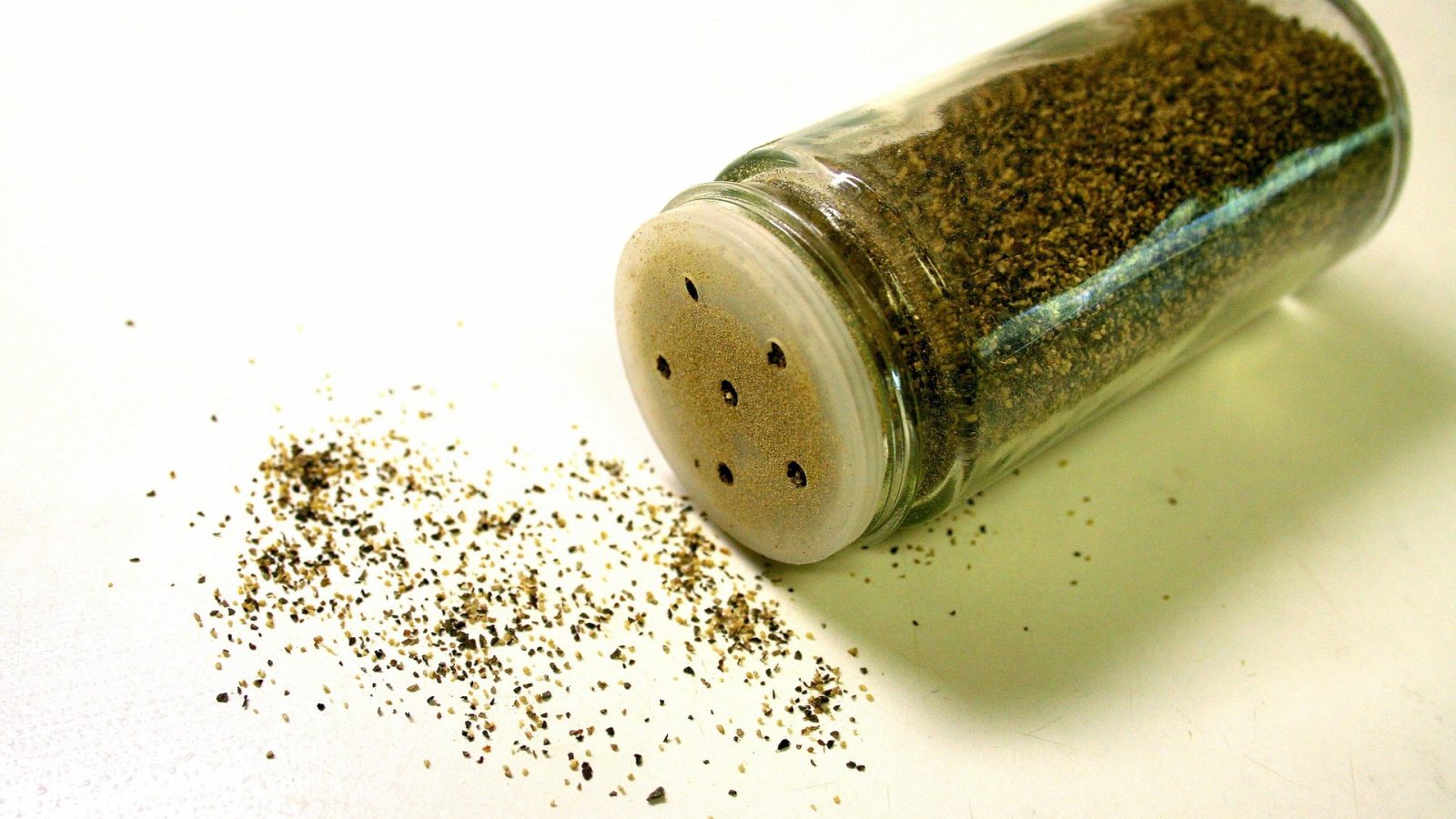
Black pepper’s most famous piece of chemistry, its ability to boost the absorption of other compounds, is real, well documented and frequently misapplied. Here is what piperine actually does, and why that does not automatically make a black pepper serum work any harder.
Search for black pepper skincare and one claim appears again and again: that piperine, the compound responsible for pepper’s heat, boosts the absorption of other active ingredients, making whatever it is blended with work better. It is a genuinely appealing idea, and it is not invented from nothing. Piperine’s bioavailability-enhancing effect is one of the better established findings in botanical pharmacology. The trouble is where, and how, that research was actually conducted, and how far it has since travelled from its original context.
What piperine is actually known to do
Piperine is the alkaloid responsible for black pepper’s pungency, and it has attracted very substantial pharmacological research interest, most famously for its ability to increase the bioavailability of numerous orally administered compounds. This is not a fringe or poorly supported claim. Researchers have shown that piperine can inhibit certain drug-metabolising enzymes and efflux transporters in the gut and liver, alter intestinal membrane permeability, and increase gastrointestinal blood flow, collectively increasing the proportion of a co-administered compound that reaches systemic circulation after being swallowed. It is precisely this effect that led to black pepper extract, standardised piperine, being combined with turmeric supplements, since curcumin on its own is notoriously poorly absorbed from the gut, and several human studies have shown that co-administering piperine can significantly increase circulating curcumin levels.
That is a real, mechanistically explained, orally demonstrated pharmacological effect. It is also, importantly, not the same thing as what a cosmetic marketing claim usually implies.
The gap that marketing quietly skips over
The entire piperine bioavailability story is about the gastrointestinal tract: enzymes in the gut wall and liver that would otherwise break a compound down before it reaches the bloodstream, transporters that would otherwise pump it back out of intestinal cells, and blood flow that carries absorbed material away into systemic circulation. None of those mechanisms describe what happens when a cream is massaged into skin.
Skin is not a passive gateway. The outermost layer, the stratum corneum, is a purpose-built barrier of tightly organised corneocytes and lipids specifically evolved to keep most things out, a very different environment from the gut lining, which is built to absorb nutrients efficiently. Applying a piperine-containing product to the surface of the skin does not recreate the enzymatic inhibition, altered gut permeability or increased gastrointestinal blood flow that piperine’s oral research actually measured. There is no good published evidence that adding piperine or black pepper extract to a cream or serum meaningfully increases the skin’s absorption of other active ingredients applied alongside it. The claim borrows the credibility of a genuinely well-established finding and applies it to an entirely different route of administration, where it has not been demonstrated.
Why the claim spreads anyway
It is easy to see why this particular piece of borrowed science has proven so durable. The oral bioavailability research is real, published in respectable journals and easy to find, which makes it simple to cite. It also offers a satisfying story: pair a hero ingredient like vitamin C or retinol with a helper ingredient that supposedly makes it work harder, and the resulting product sounds more sophisticated than either ingredient alone. That is a compelling piece of marketing logic. It is considerably less compelling as a piece of dermatological pharmacology, and the distinction between the two matters more here than almost anywhere else in this Library.
So does black pepper do anything for skin?
Possibly, though the honest answer is that direct human clinical evidence remains thin, and what exists points somewhere different from absorption-boosting. Piperine has demonstrated anti-inflammatory activity in animal models relevant to psoriasis-like and atopic-dermatitis-like inflammation, and separately reduced markers of oxidative stress in UV-B-irradiated human skin cells grown in the laboratory. A piperine-containing hydrogel has also shown accelerated wound closure in a single rat study. These are genuinely interesting mechanistic findings that identify plausible biological pathways, and each is discussed in full in the Black Pepper monograph. None of them, however, are clinical trials in people, and none of them have anything to do with boosting the absorption of other ingredients. They describe piperine acting on its own, within experimental models, on inflammatory and oxidative pathways, which is a completely separate question from whether it helps a serum work harder.
The same caution applies to black pepper’s other popular cosmetic claims. Its genuine warming, rubefacient sensory effect, real enough to feel in a massage oil, has not been well demonstrated in controlled trials specifically for reducing the appearance of cellulite, and a single combination study pairing piperine with capsaicin for alopecia areata does not establish that black pepper alone regrows hair.
What this means in practice
None of this makes black pepper an uninteresting ingredient. It has real, well-documented chemistry, a plausible and partially studied role in inflammatory skin pathways, and an entirely undisputed talent for smelling warm, dry and distinctive in a fragrance composition, which is exactly the role it plays across two of the blends in our own autumn essential oil collection. What it does not have is good evidence that adding it to a cosmetic product will make the other ingredients in that product absorb better. If a serum works, it is worth asking what evidence exists for the ingredients actually claimed to be doing the work, rather than assuming a pinch of pepper is quietly boosting everything else in the bottle.
Piperine’s real achievement, helping the body absorb more curcumin when the two are swallowed together, is a legitimately interesting piece of pharmacology. It simply belongs to a different chapter of the body than the one skincare marketing usually borrows it for.
Continue exploring
Botanical Library · Monograph No. 006
Black Pepper, Piper nigrum
The complete ingredient monograph, including chemistry, ingredient forms and the full evidence for skin and hair.
Botanical Archives · No. 006
Black Pepper and the Trade That Reshaped the World
How a small dried berry from the Malabar Coast became valuable enough to be used as currency, and helped drive the Age of Exploration.
Botanical Rituals · No. 006
The Warm-Down
The post-exercise black pepper massage oil this article’s honesty about piperine directly informs.
References
- Bioavailability enhancers of herbal origin: an overview. Asian Pacific Journal of Tropical Biomedicine. PMC3634921
- Piperine ameliorates psoriatic skin inflammation by inhibiting the phosphorylation of STAT3. International Immunopharmacology. ScienceDirect
- Piperine ameliorates trimellitic anhydride-induced atopic dermatitis-like symptoms by suppressing Th2-mediated immune responses via inhibition of STAT6 phosphorylation. International Journal of Molecular Sciences. PMC7248773
- Antioxidant and anti-inflammatory effects of piperine on UV-B-irradiated human HaCaT keratinocyte cells. Life Sciences. ScienceDirect
- Enhanced in vivo wound healing efficacy of a novel piperine-containing bioactive hydrogel in excision wound rat model. Gels. PMC9861729