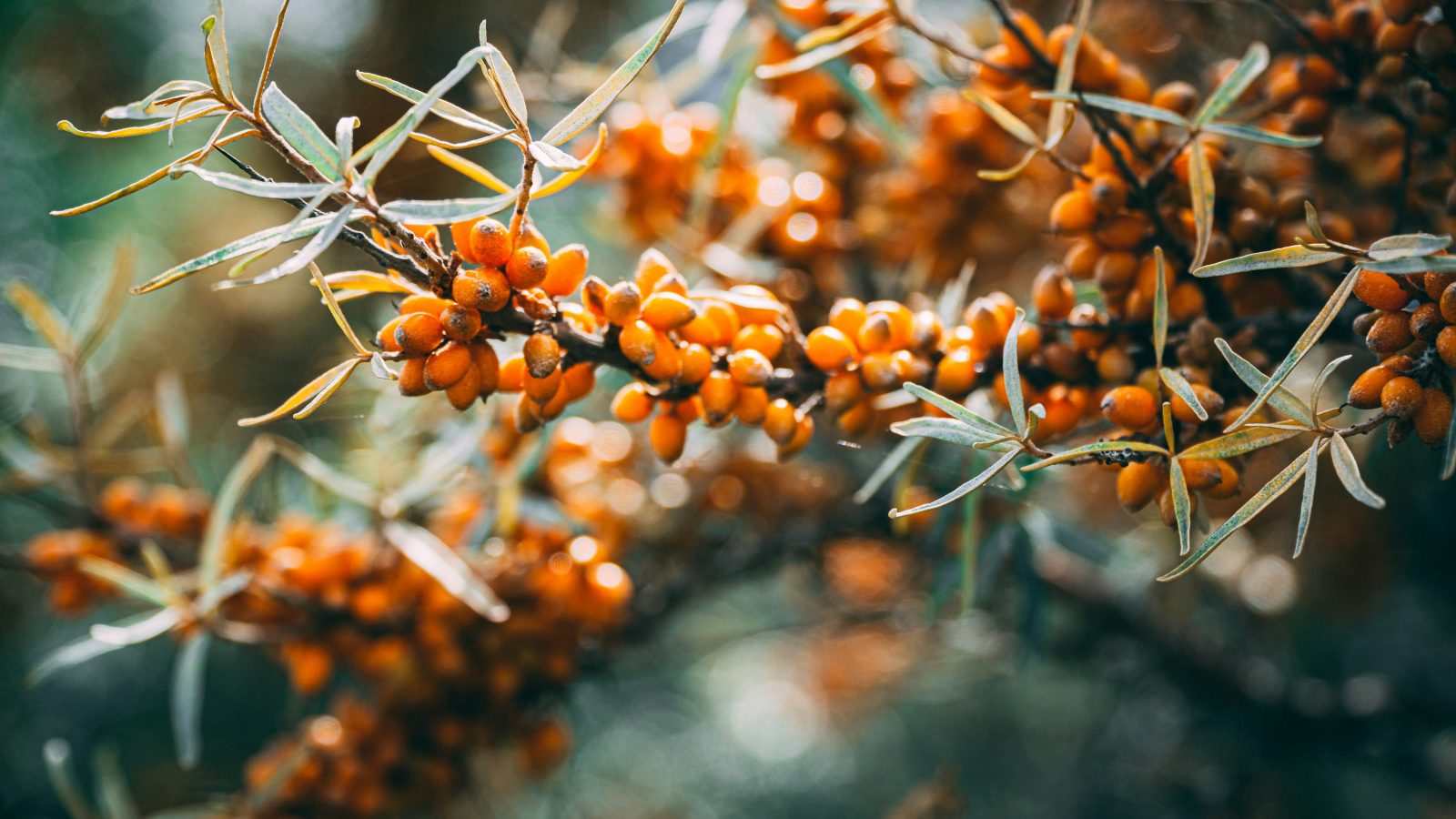
There is a particular kind of beauty to sea buckthorn in the evening. Perhaps it is the colour: the deep orange of the fruit seems to hold onto the last warmth of the day, somewhere between amber and firelight, and when that colour appears in a facial oil or balm it creates an immediate association with autumn, late summer and the low northern sun. Perhaps it is also the plant itself, a thorny, resilient shrub capable of growing in exposed places, storing colour and oil within its berries while wind and cold move around it. Whatever the reason, sea buckthorn feels naturally suited to the end of the day.
This ritual is not intended as treatment, nor as an attempt to turn skincare into something mystical. It is simply a considered evening practice built around cleansing, hydration, emollience and rest, using sea buckthorn as the botanical focus. The science behind the ingredient is interesting enough without asking it to perform miracles: its oils provide unusual fatty-acid profiles, its pulp oil carries the carotenoid pigments responsible for that extraordinary orange colour, and preliminary human research gives us some reason to take its role in barrier-supportive skincare seriously, as we discuss in the Sea Buckthorn monograph and its companion article. The ritual therefore begins not with a claim but with a purpose: to leave the skin comfortably cleansed, hydrated and protected at the end of the day, while creating a small period of quiet around an otherwise ordinary act.
Why evening?
Evening skincare offers a practical advantage, because the skin no longer needs to accommodate makeup, environmental exposure or the sensory demands of the day ahead. Richer textures can be used more comfortably, and there is time to allow oils and creams to settle without worrying about how they behave beneath sunscreen or cosmetics. It is also the point at which many people finally stop touching their face and moving between different environments, so the evening routine can be simpler than we often make it: remove what has accumulated during the day, return water to the surface, reduce the dry, tight feeling that can follow cleansing, and then leave the skin alone. Sea buckthorn fits naturally within that philosophy, because its strongest cosmetic role is not dramatic transformation but a contribution to the lipid phase of a formulation, supporting emollience, softness and sensory richness in the final step. That is enough.
The ritual, step by step
Cleanse without stripping. If sunscreen or makeup has been worn, an oil or balm cleanser may be used first, followed by a mild water-based cleanser if necessary, aiming to remove residues without creating the tight, squeaky sensation often mistaken for cleanliness. Warm water is preferable to very hot water, particularly for dry or reactive skin, and it is better to use the hands first and then press a soft warm cloth gently against the face rather than rubbing vigorously. This part of the ritual should feel almost uneventful, because good cleansing rarely looks dramatic; it simply leaves the skin ready for what follows. Our article on the skin barrier explains why gentleness matters here.
Restore water before oil. One of the most common misunderstandings in facial-oil routines is the belief that oil itself hydrates the skin. Strictly speaking oils are not sources of water; they act as emollients and, depending on the formulation, may help reduce the rate at which water leaves the skin, which is why applying a botanical oil to slightly damp or recently moisturised skin feels considerably more comfortable than applying it to completely dry skin. After cleansing, apply a simple hydrating layer, perhaps a fragrance-free toner, essence or serum containing familiar humectants such as glycerin, panthenol, hyaluronic acid or betaine. Nothing elaborate is required, and if the skin is particularly reactive the simplest possible formulation is usually best, because a ritual becomes more effective when unnecessary complexity is removed.
The sea buckthorn layer. If using a professionally formulated facial oil containing sea buckthorn seed or pulp oil, place a small amount between the fingertips and distribute it gently across the face and neck, aiming for an even, comfortable layer rather than a heavy film. It is worth knowing which oil the formulation contains, because seed oil is typically richer in linoleic and alpha-linolenic acids while pulp oil contains much greater proportions of palmitic and palmitoleic acids together with carotenoid pigments, and pulp oil in particular can be intensely coloured. That colour is part of its appeal, but it also means more is not necessarily better: a small quantity can impart a warm golden tone, while excessive use may produce obvious orange staining or transfer to pale fabrics. The colour should feel like a trace of the berry, not a costume.
Massage for comfort, not performance. Facial massage is often surrounded by exaggerated claims involving detoxification or permanent reshaping of facial contours, which is not the purpose here; a short, gentle massage can simply make the application more pleasurable and create a moment of physical attention at the end of the day. Use the fingertips or the flat surfaces of the fingers with light pressure, moving slowly from the centre of the face outward, treating the delicate skin around the eyes with particular restraint. Two or three minutes is enough, and if massage causes redness or dragging, reduce the pressure or stop, because the ritual should never become another task the skin has to endure.
Seal with a barrier-supportive moisturiser. If the skin is dry, mature or simply more comfortable with a cream at night, follow the oil with a moisturiser containing ingredients that support the barrier more directly, such as ceramides, cholesterol, glycerin, panthenol and appropriate emollients, and perhaps additional tocopherol as discussed in our Vitamin E monograph. This layering reflects the way good formulation works, because no single botanical carries the entire burden: the humectant layer provides water-binding support, the sea buckthorn contributes emollience and botanical lipids, and the moisturiser provides additional barrier support and helps reduce water loss, so the finished routine becomes stronger precisely because each component performs a different function.
Leave the skin alone. The final step is the simplest, which is to do nothing. There is a tendency within modern skincare to treat every evening as an opportunity to introduce another active, acid, mask, peel or intensive treatment, but sometimes the most useful intervention is to stop. Once the skin has been gently cleansed, hydrated and comfortably moisturised, there is no need to keep adding; dim the lights, put the products away and allow the ritual to end. The value of a skincare routine lies partly in what it does and partly in what it prevents us from doing unnecessarily, a principle we return to in our rose water ritual and in restorative yoga.
A warm drink and a quiet setting
A ritual built around sea buckthorn naturally invites a warm drink, but this is one area where the distinction between cosmetic and food use must remain clear: do not make tea from cosmetic-grade sea buckthorn ingredients. If a commercially prepared food-grade sea buckthorn tea or fruit product is available it can make an enjoyable accompaniment, particularly blended with other culinary botanicals such as rosehip, apple or ginger, though the drink is not required for the skincare routine to work; it simply extends the botanical theme into another sensory form, and warmth, acidity and fruit can create a pleasant contrast with the richness of the oil.
Part of the pleasure of botanical rituals is that they need not depend entirely upon the active ingredient. A soft cloth, low lighting and a few minutes without a screen can change the experience of an ordinary routine without making any medical claim, and for sea buckthorn I would keep the surroundings warm rather than overly decorative: a cream or amber towel rather than white, partly because deeply pigmented pulp oil may transfer if applied too generously, a warm lamp rather than bright bathroom lighting, and a simple tray rather than a row of unnecessary products. The ingredient already provides enough colour; the rest of the ritual can remain quiet.
Why it works, and what it does not do
The practical logic is straightforward: gentle cleansing removes the day’s residue without stripping the skin, a humectant layer adds water-binding support, sea buckthorn oil contributes emollience and an unusual mixture of fatty acids and lipid-soluble constituents, and a barrier-focused moisturiser reduces dry sensation and supports comfortable overnight wear. There is preliminary human evidence that a sea-buckthorn-containing emulsion may improve skin hydration and transepidermal water loss over time, although the study was small and should not be treated as proof that every formulation will behave the same way, which is why the ritual remains modest in its promises. It is designed around what skincare can reasonably do: cleanse, hydrate, condition, protect, then stop.
Equally, it is worth being clear about what the ritual does not do. It does not detoxify the skin or draw out impurities, it does not stimulate some undefined process of regeneration simply because sea buckthorn contains omega-7, and it does not treat eczema, rosacea, acne or any other dermatological condition, heal wounds or reverse ageing. Those claims belong either to marketing or to medical research questions that require substantially stronger evidence than a cosmetic ritual can provide, and the absence of such claims does not make the ritual less meaningful; it makes it more honest.
Adapting the ritual
For particularly reactive skin, reduce the ritual to its essentials: a mild cleanser, a simple hydrating product and a fragrance-free moisturiser, introducing sea buckthorn through a finished cosmetic product rather than applying a raw oil simply because it is natural. A small-area trial can help identify obvious immediate intolerance, though it cannot predict every future reaction, and it is best to avoid adding multiple new botanical products at once, because if irritation occurs it becomes difficult to identify the cause. If a retinoid or exfoliating acid already forms part of the evening routine, the sea buckthorn step can remain purely supportive and should not be treated as protection against irritation caused by overuse; there is little value in combining an aggressive treatment schedule with an ever-longer list of soothing botanicals, and if the skin is persistently red, painful or peeling the answer is usually to reconsider the active routine rather than to add more products.
The ritual suits the transition from late summer into autumn, when the colour of sea buckthorn berries mirrors the change in light and the skin begins to meet colder air and central heating, but it need not change dramatically with the season; the texture can, with a light emulsion or a few drops of oil in warmer months and a richer cream or balm in colder weather, while the underlying logic stays the same, responding to how the skin behaves rather than to a rigid calendar. And on evenings when there is no appetite for ritual, the whole practice reduces to five minutes: cleanse gently, apply hydration, use a small amount of sea-buckthorn-containing oil or moisturiser, and finish with a barrier cream if needed. The longer version exists for pleasure, not obligation, because a ritual that only works when there is plenty of time quickly becomes another source of pressure, and the best rituals survive ordinary days.
A botanical note
Sea buckthorn deserves its place in an evening ritual partly because the ingredient is so visually expressive. A pale botanical oil can disappear into a formulation without leaving much trace of the plant that produced it, whereas sea buckthorn pulp oil does the opposite: its colour insists upon its botanical origin, and that vivid orange is the result of chemistry, particularly the carotenoid pigments accumulated within the fruit. It reminds us that skincare ingredients do not begin as names on an INCI list but in tissues, seeds, leaves, flowers, fruits and roots, and in the case of sea buckthorn they begin as bright berries gathered from a thorny shrub capable of surviving some remarkably difficult landscapes, a history we follow in The Orange Berry of the North. The ritual becomes more interesting when that connection is preserved.
There is something quietly appropriate about ending with an ingredient whose reputation has become larger than its evidence. Sea buckthorn is marketed as restorative and transformative, yet its most defensible cosmetic value may be considerably simpler: an unusual, beautiful botanical lipid that can contribute to a well-designed routine for dry or uncomfortable-feeling skin. Perhaps that is enough, because not every ritual needs to promise transformation; some are valuable because they create continuity, the same few steps, the same familiar bottle, the warm colour of the oil and the point at which the day’s activity finally stops. Sea buckthorn does not need to heal everything in order to belong there. It only needs to perform its modest role well, much as rose and lavender earn their place through pleasure and history rather than medicine.
Explore sea buckthorn further
Safety note and references
This ritual is intended for ordinary cosmetic skincare and should not be interpreted as medical treatment. Use professionally formulated products according to their instructions; raw cosmetic ingredients should not be consumed, and food-grade products should not automatically be assumed suitable for topical formulation. Sea buckthorn products may cause irritation or intolerance in some individuals, and highly pigmented pulp oil can stain fabrics or temporarily colour the skin when used at excessive concentrations. Anyone experiencing persistent skin symptoms, inflammation or suspected dermatological disease should seek appropriately qualified medical advice rather than relying upon a botanical skincare routine.
- Khan, B.A., Akhtar, N. & Mahmood, T. (2014). Hippophae rhamnoides oil-in-water emulsion improves barrier function in healthy human subjects. Pakistan Journal of Pharmaceutical Sciences, 27(6), 1919-1922. PubMed: 25362595