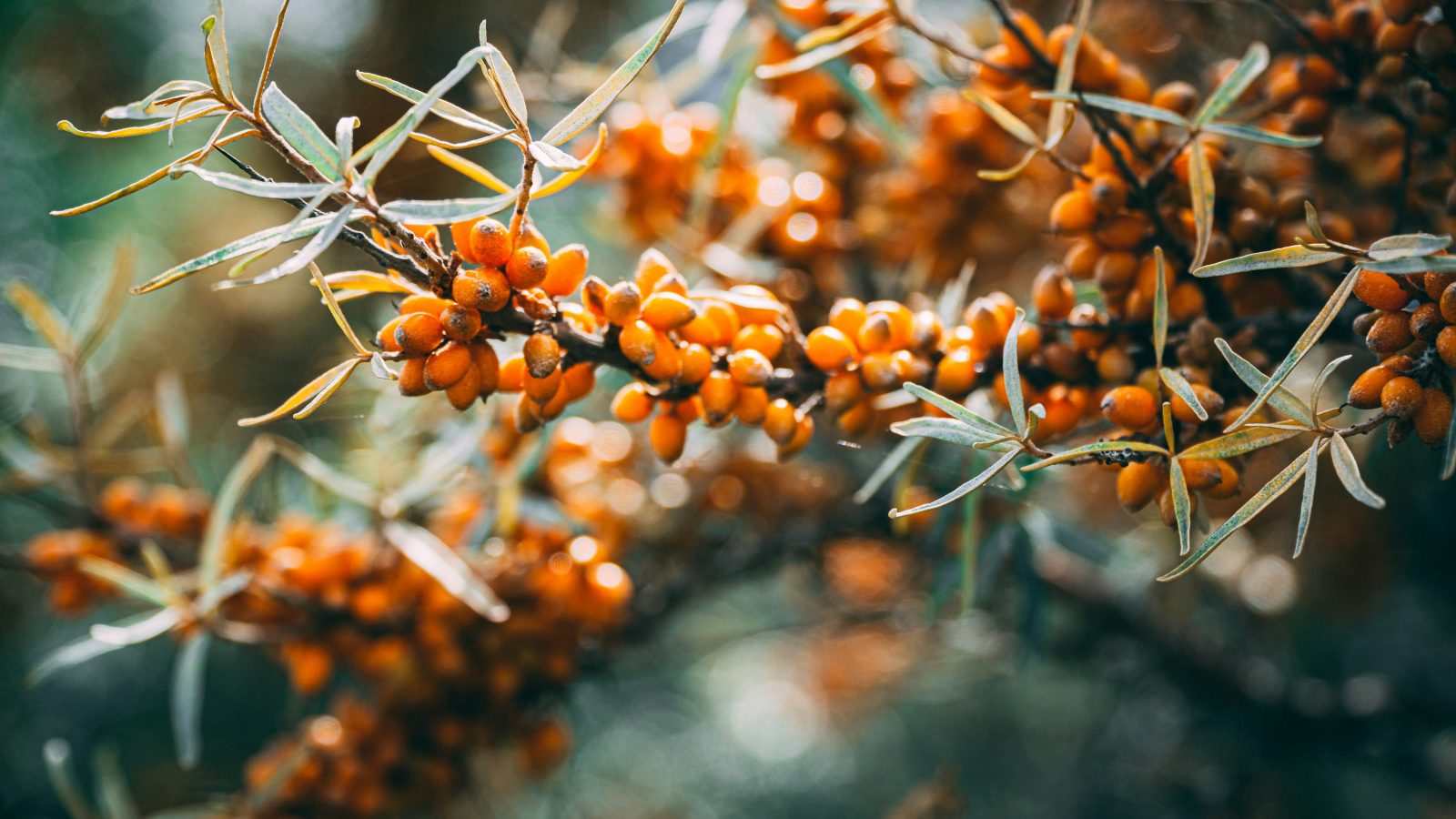
There is something unusually persuasive about sea buckthorn. The berries of Hippophae rhamnoides are intensely orange, the plant survives across exposed northern coasts and severe continental landscapes, and its oils contain an impressive collection of fatty acids, carotenoids, tocopherols and phytosterols. Add a long history of traditional use across Europe and Asia and it is easy to understand why sea buckthorn has become such an attractive ingredient for contemporary skincare. The modern language surrounding it is correspondingly ambitious: the oil is variously described as regenerating skin, repairing the barrier, reducing inflammation, treating acne, soothing eczema and reversing visible ageing, while the prominence of palmitoleic acid, or omega-7, has added another compelling marketing story.
None of these ideas appeared from nowhere. Sea buckthorn really does possess unusual chemistry, and modern research provides credible reasons to investigate its effects on the skin. The difficulty begins when biochemical plausibility, animal experiments and small preliminary human studies are presented as though they all constitute the same level of evidence, which they do not. This article is the accessible companion to our full Sea Buckthorn monograph; here we ask a simpler question: what do we actually know?
First, there is no single sea buckthorn oil
Before considering what sea buckthorn might do for skin, it is important to establish what we mean by sea buckthorn oil, because the term is commonly used for two chemically different materials. Seed oil is obtained from the seeds and is characteristically rich in the polyunsaturated fatty acids linoleic acid and alpha-linolenic acid, whereas pulp oil, obtained predominantly from the fleshy fruit surrounding those seeds, contains substantially more palmitic and palmitoleic acids and usually carries the intense carotenoid pigmentation responsible for its orange-red appearance. The difference is not subtle: in a controlled clinical study the seed oil contained approximately 34 per cent linoleic acid, 25 per cent alpha-linolenic acid and 19 per cent oleic acid, while the pulp oil contained approximately 33 per cent palmitic acid, 26 per cent oleic acid and 25 per cent palmitoleic acid.
This distinction immediately changes the skincare conversation. When a product advertises omega-7-rich sea buckthorn it is predominantly drawing attention to the chemistry of the pulp oil, whereas discussion of high linoleic and alpha-linolenic content is much more likely to concern the seed oil, so a cosmetic containing one cannot simply inherit every claim associated with the other. It is a useful reminder that botanical names tell us where an ingredient came from but not necessarily what is inside it, exactly as we found with rose, where water, essential oil, absolute and rosehip oil are entirely different materials.
Why is sea buckthorn interesting for the skin barrier?
To understand why sea buckthorn attracts dermatological interest, we first need to understand what the skin barrier actually is. As we explain in The Skin Barrier, the outermost layer of the epidermis, the stratum corneum, can be pictured through a bricks-and-mortar analogy in which corneocytes form the bricks and an organised extracellular lipid matrix of ceramides, cholesterol and fatty acids forms much of the mortar; this structure restricts excessive water loss while protecting the tissues beneath. When barrier function is compromised, transepidermal water loss can increase and the skin may become dry, rough or more reactive.
Plant oils contribute to skincare primarily as emollients, filling irregularities on the skin surface, improving flexibility and changing the way dry skin feels, and their fatty acids and minor compounds can also interact with skin biology, although these interactions are far more complicated than the popular idea that applying an oil simply replaces missing skin lipids. Sea buckthorn seed oil is particularly interesting because of its linoleic and alpha-linolenic acid content, while pulp oil provides the distinctive combination of palmitic, oleic and palmitoleic acids. That chemistry provides a credible reason to investigate sea buckthorn in barrier-focused skincare, but plausibility is only the beginning.
Has sea buckthorn actually been tested on human skin?
Yes, although the human evidence is much smaller than the popularity of the ingredient might suggest. One particularly relevant study examined an oil-in-water emulsion containing 5 per cent Hippophae rhamnoides extract in thirteen healthy male volunteers over 84 days, measuring skin hydration with a corneometer and transepidermal water loss with a tewameter and comparing the sea-buckthorn-containing formulation with the corresponding base. The active formulation produced statistically significant improvements in both hydration and water loss, which is genuinely interesting because it moves beyond demonstrating antioxidant activity in a laboratory dish and actually measures changes in human skin.
It is also important not to make the study larger than it is. There were only thirteen participants, all healthy men of around 27, and the researchers studied one particular emulsion containing one particular preparation, so the result does not establish that every sea buckthorn oil at every concentration in every formulation will behave the same way, nor that 5 per cent is a scientifically determined ideal. What it gives us is more modest and more useful: preliminary human evidence that a properly formulated sea-buckthorn-containing emulsion may positively influence measurements associated with skin hydration and barrier function, which for a botanical cosmetic ingredient is a worthwhile finding.
What about omega-7?
Omega-7 has become inseparable from the contemporary sea buckthorn story. The compound of greatest interest is palmitoleic acid, a sixteen-carbon monounsaturated fatty acid that occurs naturally within human tissues and is found at unusually high concentrations in sea buckthorn pulp oil, which makes pulp oil scientifically distinctive but does not mean that omega-7 automatically rebuilds human skin. This is where skincare language often jumps several steps ahead of biology, because the fact that a molecule occurs naturally within the body does not demonstrate that applying an external source of it recreates the structure from which it originated; human skin is metabolically active, and lipids are synthesised, transformed, transported and organised through complex processes. Palmitoleic acid therefore provides a legitimate reason to be interested in pulp oil, but there is an important difference between saying that pulp oil is an unusually rich botanical source of palmitoleic acid, which is chemistry, and saying that omega-7 rebuilds damaged skin, which is a clinical claim.
Can sea buckthorn help dry skin?
This is probably one of the more reasonable uses of the ingredient. Regardless of any specialised biological effects, sea buckthorn oils are lipids that function as emollients, so a well-designed moisturiser containing sea buckthorn can contribute to surface softness and comfort while other components address hydration and water loss, and the small human study showing improvements in hydration and water loss adds preliminary support to this use. Sea buckthorn should not, however, be expected to perform the entire job of a moisturiser: an effective formulation might combine humectants that attract or retain water, emollients that improve surface feel, occlusive components that reduce water loss and, depending on the product, physiological lipids such as ceramides and cholesterol. Sea buckthorn can occupy a useful place within that system, and its value does not depend upon pretending that it replaces the system.
What about eczema?
This is where the evidence becomes more complicated. Sea buckthorn has a history of traditional use for skin complaints, and atopic dermatitis has been investigated scientifically: one placebo-controlled, double-blind study involved 49 people who consumed 5 g per day of seed oil, pulp oil or paraffin oil for four months. Dermatitis scores improved significantly in the pulp-oil group, but they also improved significantly in the paraffin-oil placebo group, while improvement in the seed-oil group did not reach statistical significance, and a related study of sixteen patients found only comparatively small changes in the fatty-acid composition of skin glycerophospholipids, concluding that it was relatively well buffered against short-term dietary modification. These studies are important precisely because the results are not spectacular; it would be easy to extract the phrase dermatitis improved significantly in the pulp-oil group and build a marketing claim around it, until the equally important observation that dermatitis also improved in the placebo group makes the interpretation considerably more cautious.
There is another important limitation: these were oral supplementation studies, so they do not demonstrate that applying sea buckthorn oil to the skin treats eczema. A Cochrane review of dietary supplements for established atopic eczema included the sea buckthorn trial among a small and heterogeneous evidence base rather than establishing supplementation as an effective therapy. For someone living with eczema, sea buckthorn therefore belongs in the category of an interesting cosmetic ingredient rather than a substitute for evidence-based dermatological care.
Is sea buckthorn anti-inflammatory, and what about rosacea?
Here the experimental evidence becomes considerably richer. Modern research has investigated sea buckthorn oils, flavonoids and other extracts across numerous inflammatory models, with reported effects on signalling pathways and mediators, and a 2025 review focusing specifically on skin and mucosal health describes anti-inflammatory, antioxidant and tissue-repair mechanisms and identifies the plant as an interesting candidate for future dermatological investigation. The key word is future, because much of this evidence comes from cell culture and animal experiments rather than large controlled human trials; that does not make the research unimportant, since preclinical science is how plausible mechanisms are identified before expensive clinical trials, but it tells us where sea buckthorn currently sits on the evidence ladder. There is enough to say that its anti-inflammatory activity deserves serious investigation, and not enough to treat a sea buckthorn cosmetic as an anti-inflammatory medicine.
Sea buckthorn has also attracted interest in relation to rosacea, because inflammation, oxidative stress, vascular dysregulation and impaired barrier function all contribute to the condition, giving the plant several mechanistically relevant characteristics. The evidence specific to rosacea nevertheless remains largely preclinical, which is a good example of the difference between mechanistic relevance and demonstrated treatment: sea buckthorn possesses characteristics that make it interesting to rosacea researchers, but that does not make sea buckthorn oil a proven rosacea treatment.
Can sea buckthorn repair or heal skin?
The word repair deserves particular care. Sea buckthorn has an extensive experimental wound-healing literature, and several preparations have produced interesting results in animal and cellular models, so contemporary reviews discuss tissue repair alongside anti-inflammatory and antioxidant mechanisms. This research is valuable because it may eventually contribute to pharmacological or medical applications, but it does not mean that an ordinary facial oil should be described as healing wounds, because healthy cosmetic skin, compromised barrier function and an actual wound are not interchangeable biological situations. Products designed for intact skin should not acquire medical claims merely because an extract from the same plant performed well in an experimental wound model; for skincare, barrier support, emollience, skin conditioning and hydration are much more defensible concepts.
Does sea buckthorn fight skin ageing?
This is perhaps the area in which cosmetic language most easily outruns the evidence. Sea buckthorn contains carotenoids, tocopherols and other antioxidant compounds, and its oils can improve emollience and potentially support hydration, which makes it perfectly reasonable to include in formulations for dry or mature skin, and better-hydrated skin can look smoother and reduce the visual prominence of superficial fine lines. None of this demonstrates reversal of biological ageing, which involves changes in collagen and elastin, extracellular-matrix organisation, pigmentation, vascular structures, cellular senescence and accumulated environmental damage; demonstrating antioxidant activity in an extract does not establish clinically meaningful reversal of those processes. Sea buckthorn can form part of a thoughtful approach to mature skin, but it should not be presented as a botanical alternative to interventions with substantially stronger clinical evidence. The same careful distinction applies to vitamin E, whose antioxidant chemistry is genuine but whose anti-ageing claims frequently outrun the evidence.
Is sea buckthorn good for acne, and is it really rich in vitamin C?
The acne argument usually begins with seed oil’s linoleic-acid content and continues through its experimental anti-inflammatory activity; both are scientifically interesting, but neither establishes an acne treatment. Acne is a complex inflammatory disorder involving follicular keratinisation, sebaceous activity, Cutibacterium acnes, hormonal signalling and immune responses, and there is presently insufficient controlled human evidence to conclude that sea buckthorn oil meaningfully treats it, which does not mean people with acne-prone skin should avoid it, only that tolerating an ingredient and treating acne with it are two different propositions. As for vitamin C, the berry can be rich in it but the oil is another matter: vitamin C is water soluble, whereas fixed oils predominantly contain lipid-soluble compounds, so it is misleading to transfer the nutritional profile of the fresh berry wholesale onto seed or pulp oil. Sea buckthorn oil is far more interesting for its fatty acids, carotenoids, tocopherols and phytosterols, and a formulation requiring a defined vitamin C active should contain an appropriately characterised vitamin C ingredient, because an orange berry on the label is not an analytical specification.
So, is sea buckthorn worth using?
I think it is, provided we allow it to be what the evidence suggests rather than what botanical marketing sometimes wants it to become. Sea buckthorn is more scientifically interesting than many fashionable superfood ingredients that have migrated into cosmetics: the distinction between seed and pulp oils gives formulators access to genuinely different lipid profiles, pulp oil provides an unusual botanical source of palmitoleic acid, carotenoids and tocopherols add antioxidant chemistry, and preliminary human evidence gives us some reason to take the skin-barrier story seriously. At the same time the clinical literature remains relatively small, the human topical barrier study involved only thirteen participants, the atopic-dermatitis supplementation study produced mixed results, and much of the evidence concerning inflammation and tissue repair remains preclinical. That leaves sea buckthorn in a position I find more interesting than either miracle ingredient or marketing nonsense: a promising, chemically distinctive botanical emollient with preliminary evidence for skin-barrier benefits and a substantial body of experimental research not yet fully translated into human clinical evidence. There is nothing disappointing about that conclusion, because good skincare does not require miraculous ingredients, only ingredients with sensible functions combined intelligently, used at appropriate concentrations and described without asking the science to say more than it does. Sea buckthorn meets that standard rather well, much as lavender does when its fragrance and history are valued without turning it into a medicine.
The short answer
- Hydration and emollience: a sensible chemical basis and preliminary human evidence.
- Skin-barrier support: promising, with a small human study showing improvements in hydration and water loss.
- Inflammation: interesting experimental evidence, but much of it remains preclinical.
- Eczema: insufficient evidence to regard sea buckthorn as a treatment; oral trials should not be confused with topical evidence.
- Rosacea: biologically interesting but not clinically established.
- Acne: insufficient clinical evidence for treatment claims.
- Anti-ageing: useful emollient and antioxidant chemistry, but no convincing evidence that it reverses established ageing.
- Overall: a worthwhile skincare ingredient whose genuine scientific interest is more compelling when separated from exaggerated claims.
Explore sea buckthorn further
Botanical Library · Monograph No. 004
Sea Buckthorn, Hippophae rhamnoides
The complete scientific review: botanical identity, seed and pulp oils, chemistry, dermatological evidence, safety, sustainability and cosmetic formulation.
Botanical Archives · No. 004
The Orange Berry of the North
The cultural history of the orange berry across Eurasia, from shining horses and Tibetan medicine to Soviet research and the modern superberry.
Botanical Rituals · No. 004
The Golden Hour
An evidence-conscious evening skincare ritual built around sea buckthorn, without turning traditional history into therapeutic claims.
References
- Yang, B., Kalimo, K.O., Mattila, L.M. et al. (1999). Effects of dietary supplementation with sea buckthorn seed and pulp oils on atopic dermatitis. Journal of Nutritional Biochemistry, 10(11), 622-630. doi:10.1016/S0955-2863(99)00049-2
- Yang, B. et al. (2000). Effect of dietary supplementation with sea buckthorn seed and pulp oils on the fatty acid composition of skin glycerophospholipids of patients with atopic dermatitis. Journal of Nutritional Biochemistry, 11(6), 338-340. doi:10.1016/S0955-2863(00)00088-7
- Khan, B.A., Akhtar, N. & Mahmood, T. (2014). Hippophae rhamnoides oil-in-water emulsion improves barrier function in healthy human subjects. Pakistan Journal of Pharmaceutical Sciences, 27(6), 1919-1922. PubMed: 25362595
- Song, X., Sun, X., Yuan, H., Tang, Y. & Zheng, F. (2025). The role of sea buckthorn in skin and mucosal health: a review from an anti-inflammatory perspective. Frontiers in Pharmacology, 16, 1643146. doi:10.3389/fphar.2025.1643146
- Bath-Hextall, F.J. et al. Dietary supplements for established atopic eczema. Cochrane Database of Systematic Reviews. doi:10.1002/14651858.CD005205.pub2