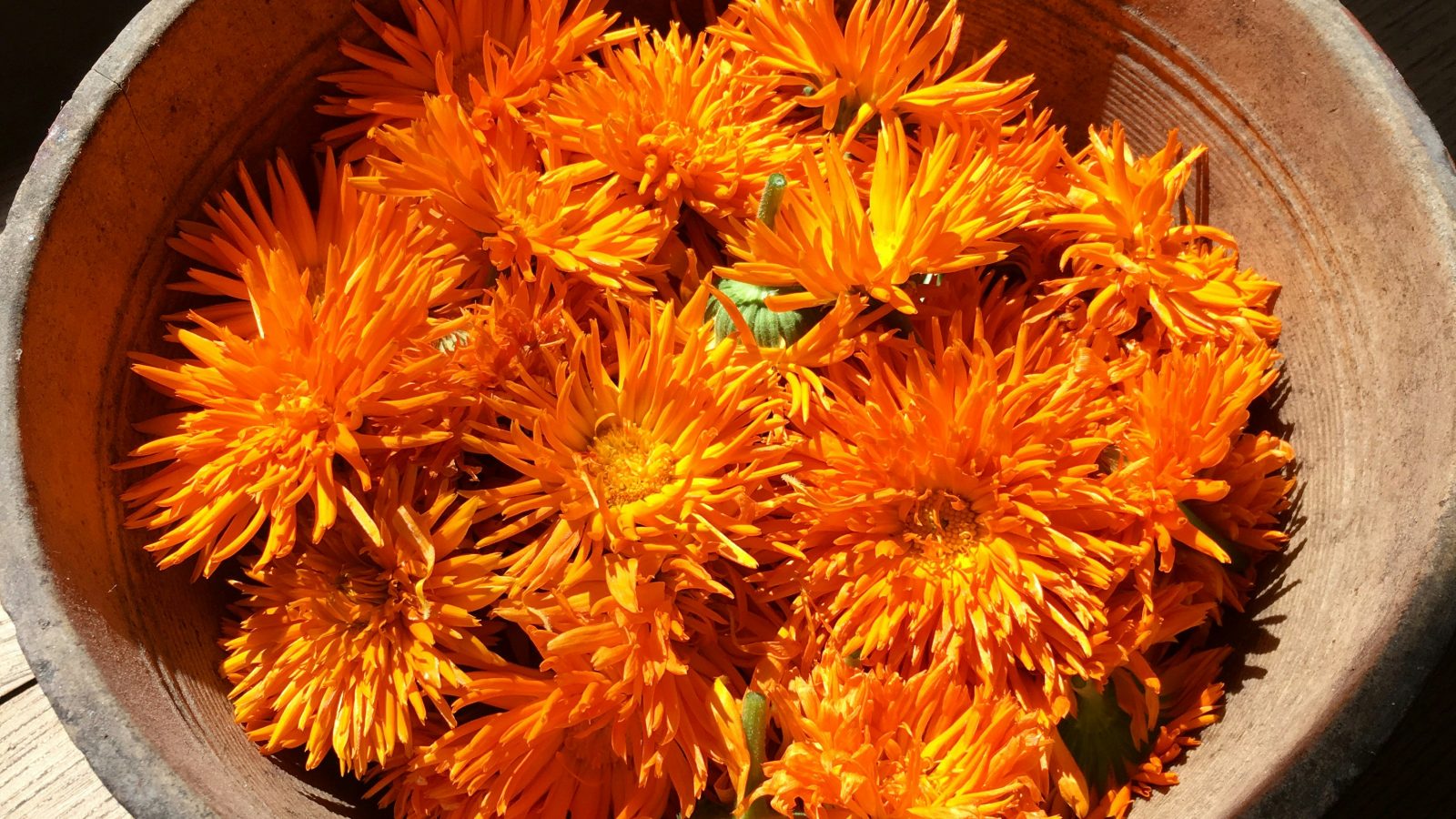
We have spent much of this month’s exploration of calendula talking about skin. That is understandable, since Calendula officinalis has been associated with salves, ointments and preparations for uncomfortable or damaged skin for generations, and that history continues to influence the way the botanical is marketed today, as we discuss in the complete Calendula monograph. But calendula has another history. It belongs in the kitchen. The bright yellow and orange petals are edible and have traditionally been added to soups, stews, rice, butter and other foods, where their intense colour was often at least as important as their flavour. That makes calendula an interesting ingredient for the Botanical Kitchen. It does not need to become a medicinal tea, and we do not need to claim that putting it into a biscuit transforms shortbread into a health food. We can simply cook with it, and sometimes that is the nicest way to understand a botanical.
The flower once called poor man’s saffron
Calendula has acquired several names over its long history, and one of the most evocative is poor man’s saffron. The comparison makes sense when the flowers are sitting beside one another. True saffron comes from Crocus sativus, and each flower produces only three precious red stigmas, which must be harvested individually, so producing even a small quantity of dried saffron requires an extraordinary number of flowers and considerable human labour. Calendula offers something quite different: its flowers can produce an abundance of brilliant yellow and orange petals throughout the growing season, and added to food, those petals can contribute a warm golden colour. Historically, this made calendula useful when expensive saffron was unavailable.
But there is an important distinction. Calendula is not saffron, and it does not reproduce saffron’s distinctive flavour and aroma. Calling it poor man’s saffron describes one aspect of its historical use rather than botanical or culinary equivalence, exactly the sort of distinction we enjoy making at Botanicals and Company. Plants become more interesting when we allow them to be themselves.
What does calendula actually taste like?
Calendula is not intensely floral, and anyone expecting the perfume of rose or lavender may be surprised. The petals are relatively subtle, with a flavour often described as slightly peppery, mildly bitter, faintly earthy, vegetal and gently herbal, and different cultivars, growing conditions and the age of the flowers can influence the sensory experience. That subtlety is useful in cooking, because calendula can introduce colour and a little botanical complexity without turning everything it touches into perfume. For shortbread, that is exactly what we want. Butter provides richness, sugar provides sweetness, lemon brings fragrance and acidity, and calendula provides golden flecks and a gentle botanical note running underneath them. No ingredient needs to shout.
Choosing calendula for cooking
Before we begin, there is an important distinction between a flower being botanically edible and a particular flower being suitable to eat. For this recipe we are using Calendula officinalis, the pot marigold, which should not be confused with ornamental marigolds belonging to the genus Tagetes. Use calendula specifically grown or sold for culinary use, and do not assume flowers from a florist, supermarket bouquet or garden centre are suitable for eating, since ornamental plants may have been cultivated and treated in ways that were never intended for food production. If growing your own calendula for the kitchen, know how the plants have been grown and avoid flowers treated with products unsuitable for edible crops, or alternatively purchase dried culinary-grade calendula petals from a reputable food or herbal supplier. Cosmetic-grade calendula is not automatically food-grade calendula. The words natural and botanical do not make those categories interchangeable.
Golden Calendula & Lemon Shortbread
Makes
Approximately 18 to 22 biscuits
Prepare
20 minutes, plus chilling
Bake
15 to 18 min at 170°C (150°C fan), Gas 3
Ingredients
- 225 g unsalted butter, softened
- 100 g caster sugar
- Finely grated zest of 2 unwaxed lemons
- 300 g plain flour
- 75 g fine semolina or rice flour
- 2 to 3 tablespoons fresh culinary calendula petals, or 1 to 1½ tablespoons dried culinary calendula petals
- ¼ teaspoon fine sea salt
- A little extra caster sugar for finishing, optional
Preparing the calendula
If using fresh flowers, begin by checking them carefully. Choose fully open, healthy flowers intended for culinary use, gently remove the petals from the flower head, inspect them for insects or debris and wash them carefully if required, then dry them thoroughly between clean kitchen towels or in a salad spinner. This last step matters, because shortbread depends upon controlling moisture, and adding wet petals introduces water to a dough designed to contain very little of it. If using dried calendula, check that the petals remain fragrant and brightly coloured rather than dusty, brown or stale, and rub them very lightly between your fingers to break exceptionally large pieces without grinding them into powder. Part of the pleasure of this recipe is seeing occasional orange and yellow petals in the finished biscuit.
Method
-
Make calendula and lemon sugar
Place the caster sugar in a bowl, add the lemon zest and approximately half of the calendula petals, and use your fingertips to rub everything together for a minute or two. The sugar will begin to feel slightly damp as the lemon zest releases its aromatic oils, and its fragrance will change too. This tiny step makes an enormous difference: rather than leaving the lemon zest distributed randomly through the dough, rubbing it into the sugar helps release volatile aromatic compounds from the peel and distributes them throughout the mixture, and the calendula becomes incorporated at the same time. Leave the mixture for five minutes. You have just made the aromatic foundation of the shortbread.
-
Cream the butter
Add the softened butter to the calendula and lemon sugar and beat until smooth and evenly combined. There is no need to whip enormous quantities of air into the mixture, since we are making shortbread rather than sponge cake, and the finished biscuit should be short, dense and tender rather than light and aerated.
-
Add the dry ingredients
Combine the plain flour, semolina or rice flour and salt and add them gradually to the butter mixture, mixing gently until the dough begins to come together. Add the remaining calendula petals towards the end so that some retain their colour and shape, and stop mixing as soon as a coherent dough forms. If the mixture initially appears crumbly, resist the temptation to add water immediately; press a little between your fingers, since shortbread dough often looks considerably drier in the bowl than it actually is, and the warmth of your hands may be enough to bring it together.
-
Chill
Bring the dough together gently into a flattened disc, wrap or cover it and refrigerate for approximately 30 minutes. Chilling firms the butter, makes the dough easier to roll and cut, and helps the biscuits retain their shape during baking. Meanwhile, heat the oven to 170°C conventional, 150°C fan or Gas 3, and line a baking tray with parchment.
-
Roll and cut
Lightly flour the work surface and roll the dough to approximately 6 to 8 mm thick. Cut into rounds using a biscuit cutter and transfer carefully to the prepared baking tray, gathering the scraps together gently and rerolling once. Avoid repeatedly kneading and rerolling the dough, because excessive handling can develop the flour’s gluten and produce a tougher biscuit. If desired, press one or two particularly attractive calendula petals very gently onto the surface of each biscuit. Less is better here; we want shortbread containing calendula rather than a flower arrangement that happens to contain shortbread.
-
Bake
Bake for approximately 15 to 18 minutes, watching the edges rather than relying entirely upon the clock. The biscuits should remain relatively pale, with just the beginnings of golden colour around the edges, and calendula petals may deepen slightly during baking, which is normal. Remove the tray from the oven and, if desired, scatter a very small quantity of caster sugar across the warm biscuits. Allow them to remain on the baking tray for approximately five minutes before transferring carefully to a wire rack, since shortbread is fragile while hot and firms considerably as it cools.
Wait
This may be the hardest part. Allow the shortbread to cool completely, since the texture improves as the butter firms and the biscuit develops its characteristic short, crumbly structure. Then make tea.
Why this recipe works
Shortbread is an unusually good place to explore subtle botanical ingredients because the basic formulation is so restrained. At its heart, shortbread is an interaction between fat, sugar and flour: butter coats flour particles and limits the development of gluten, which is partly responsible for the characteristic crumbly texture described as short, sugar provides sweetness but also influences spread, browning and texture, and flour provides structure, with our semolina or rice flour modifying that structure slightly to contribute the delicate sandy quality associated with particularly good shortbread. Then we introduce two botanical ingredients: lemon peel provides volatile aromatic oils concentrated in its outer zest, and calendula petals provide pigment, visual character and a much subtler flavour contribution. Neither changes the fundamental identity of the biscuit, and that is deliberate. The best botanical recipes do not necessarily taste overwhelmingly botanical. Sometimes an ingredient works because it changes the edges of a familiar food rather than its centre.
The remarkable colour of calendula flowers is not decorative from the plant’s perspective; pigments within the petals participate in the plant’s relationship with its environment, particularly through visual signalling associated with pollination. Among the compounds responsible for the yellow-to-orange colour are carotenoids, the same broad family of pigments responsible for many familiar colours in foods and plants, including carrots, pumpkins, tomatoes and autumn leaves. Different cultivars contain different concentrations and combinations of pigments, which is why calendula flowers range from pale cream and lemon yellow through to intense burnt orange, and some of that colour survives drying and cooking. That explains much of calendula’s historical usefulness in the kitchen. Long before anyone could identify individual carotenoid molecules, cooks understood something much simpler: the petals made food golden.
Working with edible flowers
Fresh calendula gives the biscuits more visible pieces of petal and connects the recipe beautifully to a summer garden, while dried calendula is considerably more convenient and makes this recipe possible throughout the year. The two are not identical, since drying removes water and alters the concentration and stability of various plant compounds, and aroma, colour and texture may all change during the process; for this recipe those differences are relatively minor because calendula is an accent rather than the dominant flavour, though if using dried petals, use less by volume than fresh.
Edible flowers deserve the same care as any other ingredient. Being able to identify the species matters, knowing how it was grown matters, cleanliness matters, and individual tolerance matters. Do not eat a flower simply because it resembles one you recognise, since botanical identification based solely upon flower colour is particularly unreliable, and for anyone beginning to cook with flowers, purchasing ingredients specifically labelled for culinary use is the simplest approach. Introduce unfamiliar edible botanicals sensibly rather than consuming large quantities for the first time. The objective is pleasure, not bravery.
Variations
Calendula and orange. Replace the lemon zest with finely grated zest from one large unwaxed orange. Orange produces a softer, sweeter aromatic profile that works particularly beautifully with deeply coloured calendula.
Calendula, lemon and vanilla. Add one teaspoon of vanilla extract or paste with the butter. Vanilla rounds the sharper edges of the lemon and produces a slightly more dessert-like shortbread.
Calendula and rosemary. Add approximately half a teaspoon of very finely chopped fresh rosemary, using restraint, since rosemary can overwhelm calendula extremely quickly. This version works particularly well with less sugar and makes an interesting biscuit alongside cheese.
Calendula shortbread fingers. Instead of rolling the dough, press it evenly into a lined square baking tin, prick lightly with a fork, bake until just golden and cut into fingers while still warm. It is perhaps the most traditional presentation and the easiest version to make with children.
Serve the shortbread simply; tea is enough. Earl Grey works beautifully because bergamot echoes the citrus, a light black tea allows the calendula and lemon to remain noticeable, and chamomile provides an interesting bridge towards the softer botanicals we explore elsewhere in the Library, though botanical rituals should never become so prescriptive that we forget personal taste. The biscuit is the important part.
Once completely cool, store the shortbread in an airtight container, best eaten within approximately one week for optimum texture and flavour and kept somewhere cool and dry, since the volatile compounds responsible for lemon aroma gradually dissipate and the biscuits are at their most fragrant during the first few days. They can also be frozen: place completely cooled biscuits in a suitable airtight container with baking parchment between layers and freeze for up to approximately two months, defrosting at room temperature before serving.
From kitchen to laboratory
There is something rather satisfying about making this recipe during our exploration of calendula, because the same flower can appear in remarkably different contexts. In the Botanical Archives, we encounter calendula in old gardens and apothecaries. In the Ingredient Library, we examine its taxonomy, phytochemistry and cosmetic applications. In our scientific articles, we ask whether its reputation for healing survives modern scrutiny. In the Rituals collection, we use calendula as the focus of an intentionally simple skincare practice. And here, in the Botanical Kitchen, we eat it.
But these uses should not be confused. A culinary calendula petal is food. A standardised calendula extract may be a cosmetic raw material. A medicinal preparation exists within another regulatory and evidential framework. The fact that all three begin with Calendula officinalis does not make them interchangeable, and that distinction becomes increasingly important as we explore botanicals. A plant is not an ingredient. It is the source of many possible ingredients, depending upon the plant part, extraction method, concentration and intended use. Today our extraction technique is wonderfully unsophisticated: butter, sugar, heat. And the result is shortbread.
Calendula is sometimes overshadowed by the enormous reputation it has acquired within herbal medicine, which is unfortunate, because the plant is interesting even without therapeutic claims. It is easy to grow, it flowers generously, pollinators visit it, its petals have been used in food, its pigments have coloured kitchens for generations, and its extraordinary orange flowers make even a very ordinary biscuit rather beautiful. Perhaps the Botanical Kitchen is where we can allow plants to escape the constant question of what they can do for us. Not every botanical needs to improve our skin. Not every phytochemical needs to become an active. Not every traditional ingredient needs to become a supplement. Sometimes a flower can simply be delicious, or in calendula’s case, subtly peppery, brilliantly golden and surrounded by a great deal of butter. That seems quite enough.
Food safety
Use only correctly identified Calendula officinalis flowers grown or supplied for culinary use. Flowers purchased for ornamental display should not be assumed safe to eat, since they may have been treated with pesticides or other products not intended for food crops. Wash fresh culinary flowers appropriately and inspect them carefully before use. Individuals with known allergies to plants within the Asteraceae family should exercise particular caution when introducing calendula. This recipe is a food preparation and is not intended to provide medicinal or therapeutic effects.
Sources and further reading
- Royal Horticultural Society. Calendula. RHS Plant Guide. rhs.org.uk
- Royal Horticultural Society. Edible Flowers. RHS Gardening Guidance. rhs.org.uk
- Fernandes, L., Casal, S., Pereira, J.A., Saraiva, J.A. & Ramalhosa, E. (2017). Edible flowers: a review of the nutritional, antioxidant, antimicrobial properties and effects on human health. Journal of Food Composition and Analysis, 60, 38-50. doi:10.1016/j.jfca.2017.03.017
- Pires, T.C.S.P., Dias, M.I., Barros, L. & Ferreira, I.C.F.R. (2017). Nutritional and chemical characterization of edible petals and corresponding infusions: valorization as new food ingredients. Food Chemistry, 220, 337-343. doi:10.1016/j.foodchem.2016.10.026