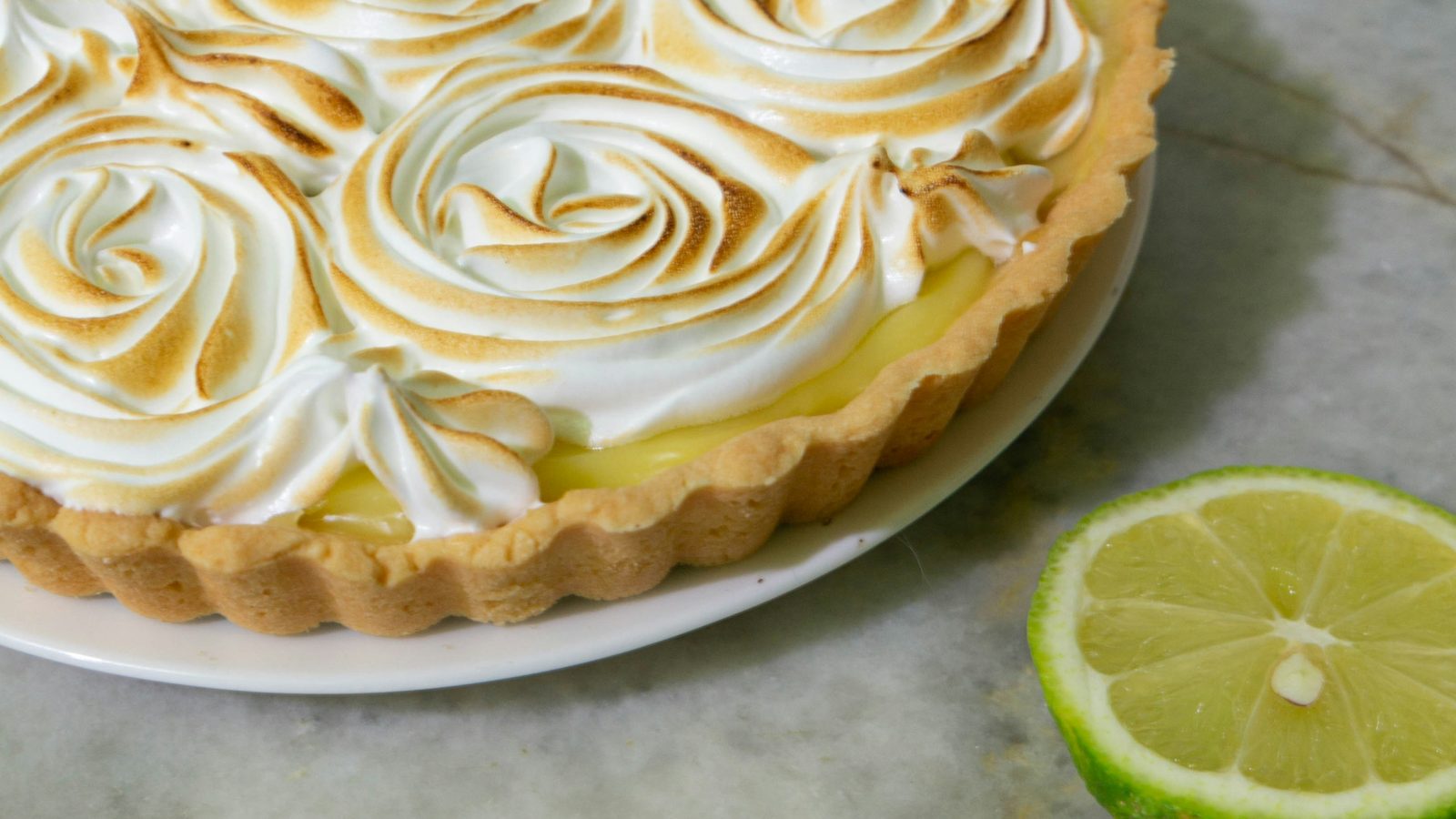
Real Key lime pie is a genuinely simple thing done properly: tart, floral Key lime juice, sweetened condensed milk, and egg yolks, set gently in a digestive biscuit crust and finished, in this version, with a pile of softly peaked, lightly browned meringue rather than cream, a topping that uses the egg whites the filling leaves spare rather than wasting them. Its full, genuinely contested history, including the 1926 hurricane that ended commercial Key lime growing in Florida almost entirely, is told in The Botanical Archives No. 010.
Makes
One 23cm pie, 8 slices
Prepare
25 minutes, plus chilling
Bake
15 min crust, 15 min filling, 5 to 8 min meringue, at 165°C (145°C fan), Gas 3
Ingredients
- 200g McVitie’s digestive biscuits, crushed to fine crumbs
- 75g unsalted butter, melted
- 2 tbsp caster sugar
- 4 large eggs, separated (yolks for the filling, whites for the meringue)
- 1 x 397g tin sweetened condensed milk
- 120ml Key lime juice, fresh if you can find true Key limes, bottled Key lime juice otherwise (see note)
- Zest of 2 limes, plus extra to finish
- 110g caster sugar, for the meringue
- ¼ tsp cream of tartar (optional, helps the meringue hold its peaks)
Method
-
Make the crust
Preheat the oven. Combine the digestive crumbs, melted butter and 2 tbsp caster sugar until the mixture resembles damp sand, then press firmly and evenly into the base and up the sides of a 23cm pie or tart tin. Bake for 12 to 15 minutes until just set and lightly golden, then remove and leave to cool slightly while you make the filling.
-
Separate the eggs
Separate the eggs, dropping the yolks into one bowl and the whites into a second, completely grease-free bowl for the meringue later; even a trace of yolk in the whites will stop them whipping properly, so take a moment to do this carefully.
-
Whisk the yolks
Whisk the egg yolks on their own for a full two minutes, until noticeably paler and slightly thickened; this step does real work in the final texture and is worth not rushing.
-
Add the condensed milk, then the lime
Whisk in the condensed milk until fully combined, then whisk in the lime juice and zest. The mixture will thicken visibly as the acid in the lime juice reacts with the milk proteins, a genuinely useful visual cue that the filling is coming together properly.
-
Bake gently
Pour the filling into the cooled crust and bake for 15 minutes, just until the filling is set around the edges but still very slightly wobbly in the centre; it will finish setting as it cools. Do not overbake, or the texture turns from silky to rubbery.
-
Chill properly
Cool to room temperature, then chill for at least 3 hours, ideally overnight, before slicing. This is not a pie to rush; a fully chilled, fully set pie slices cleanly, a warm or under-chilled one does not.
-
Whisk the meringue
Once the pie is fully chilled and just before serving, whisk the reserved egg whites with the cream of tartar, if using, until foamy, then add the 110g caster sugar a tablespoon at a time, whisking well between each addition, until the meringue is thick, glossy, and holds a firm peak when the whisk is lifted.
-
Pipe and brown
Pile or pipe the meringue generously over the chilled filling, right to the edges of the crust so it anchors and does not shrink away as it browns, then either flash under a hot grill for 1 to 2 minutes, brown carefully with a kitchen blowtorch, or bake at 220°C (200°C fan), Gas 7 for 5 to 8 minutes, watching closely, until the peaks are golden in places. Serve promptly once browned.
A note on real Key limes
True Key limes are smaller, more aromatic and noticeably more floral than the common Persian lime sold in most supermarkets, and, as the Archive piece explains, actually finding them fresh outside Florida and a few specialist grocers is genuinely difficult; bottled Key lime juice, widely available and considerably more convenient, is a completely reasonable substitute and is what most Key lime pie, including in Florida, is actually made with today. If using ordinary Persian limes instead, the pie will still be excellent, simply slightly less floral and slightly more straightforwardly tart; either way, do not substitute bottled ordinary lime juice concentrate, which lacks the fresh brightness this pie depends on.
Serving
Serve as soon as the meringue is browned and still warm on top of a properly chilled filling, in clean slices, with a little extra lime zest scattered over. The meringue is best made and browned close to serving rather than well in advance; it will hold for an hour or two but is genuinely at its best done last.
Storage
The unmeringued, chilled pie keeps well, covered, in the refrigerator for up to 3 days; make and brown the meringue only on the day you plan to serve it, since a meringue topping does not store or refrigerate well once made.
Botanical Library · Monograph No. 010
Lime
The full chemistry, evidence and, especially, the phototoxicity safety story behind this fruit’s essential oil.