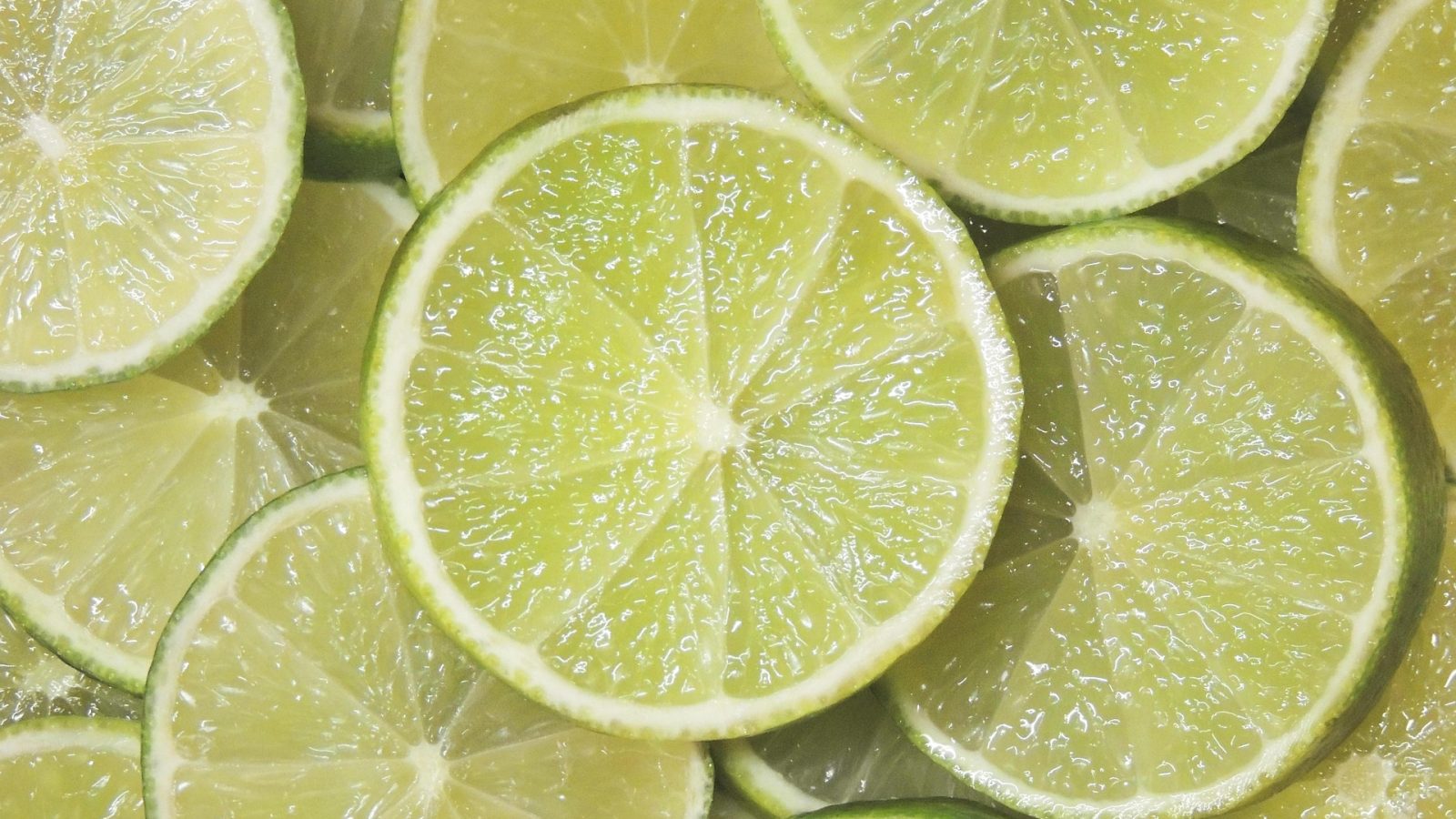
Lime is one of the more clarifying ingredients to write about in this Library, not because its evidence is unusually dramatic, but because it offers a genuinely clean case study in why an essential oil’s method of extraction can matter as much as the plant it came from. The same fruit produces two materials, expressed and distilled, that behave completely differently on skin exposed to sunlight, and conflating them is the single most consequential mistake a formulator or home user can make with this ingredient.
At a glance
| Botanical name | Citrus × aurantiifolia (Christm.) Swingle |
|---|---|
| Common names | Lime, Key lime, Mexican lime |
| Family | Rutaceae (citrus family) |
| Native range | Southeast Asia, likely the Indo-Malay region, spread through the Middle East and Mediterranean via early trade routes |
| Plant type | Small, thorny evergreen citrus tree or shrub |
| Principal part used | Peel (expressed oil) or whole crushed fruit (distilled oil) |
| Main ingredient forms | Expressed (cold-pressed) lime oil, steam-distilled lime oil |
| Principal constituents | D-limonene (majority), furocoumarins including bergapten, psoralen and limettin, concentrated almost entirely in the expressed form |
| Traditional uses | Culinary and beverage flavouring; historically issued to British sailors to prevent scurvy |
| Evidence position | Solid laboratory evidence for antimicrobial and antioxidant activity; genuine, extensively documented phototoxicity risk for the expressed form specifically |
| Principal safety consideration | Expressed lime oil is phototoxic; steam-distilled lime oil is not considered phototoxic. The two are not interchangeable for leave-on skin use |
| Botanical Library | Monograph No. 010 |
Botanical identity
Citrus × aurantiifolia belongs to Rutaceae, the citrus family, and grows as a small, dense, thorny evergreen tree or large shrub rarely exceeding five metres, bearing small, thin-skinned, highly aromatic fruit. The lime sold and grown most widely today actually splits into two commercially distinct fruits: the true Key or Mexican lime covered by this botanical name, small, seeded and intensely aromatic, and the larger, seedless Persian or Tahiti lime, a separate hybrid more commonly found in supermarkets, with a milder aroma profile. Essential oil described simply as “lime oil” in aromatherapy and formulation most often derives from the Key lime specifically, the form this monograph focuses on.
History and traditional uses
Limes are believed to have originated in the Indo-Malay region of Southeast Asia, reaching the Mediterranean and Middle East via early Arab trade routes before Spanish and Portuguese voyages carried them onward to the Caribbean and the Americas. Lime’s best-known traditional role is maritime rather than cosmetic: from the late eighteenth century, the Royal Navy issued lime or lemon juice to sailors specifically to prevent scurvy, a practice credited with the enduring British nickname “limey.” That is a genuine, well-documented piece of citrus history, though it concerns lime juice’s vitamin C content rather than the essential oil covered here, a distinction worth making plainly rather than blurring the two together.
The more recent commercial history of the Key lime specifically is worth knowing, since it explains why “Key lime” and “the lime actually available in most shops” have not meant quite the same fruit for the best part of a century. Florida’s Key lime industry, centred on the islands after which the fruit takes its common name, was largely destroyed by the Great Miami Hurricane of 1926, and rather than replant the same delicate, thorny, disease-prone variety, Florida growers switched decisively to the hardier, easier-to-transport Persian lime, the larger, seedless fruit most commonly sold simply as “lime” today. Genuine commercial Key lime production has never really returned to Florida at scale, and Key limes sold today are grown predominantly in Mexico and other warmer producing regions and shipped in, a detail that surprises people who assume “Key lime” still means Florida-grown. Essential oil described simply as lime oil in aromatherapy and formulation, as noted above, still typically derives from the Key lime specifically, regardless of where it was actually grown.
Ingredient forms
Lime essential oil’s two principal forms differ enough in composition and safety profile that they should be treated as functionally different ingredients, not interchangeable versions of the same material.
Expressed (cold-pressed) lime oil. Mechanically pressed from the fresh peel, retaining the full furocoumarin content naturally present there. This is the more traditional, more intensely fresh-smelling form, and the one responsible for essential oil’s genuine phototoxicity reputation.
Steam-distilled lime oil. Produced by distilling the whole crushed fruit or peel, a process that leaves the great majority of the heavier, non-volatile furocoumarin compounds behind rather than carrying them over into the distillate. Distilled lime oil has a slightly different, often described as greener or less sweet, aroma than the expressed form, and is not considered phototoxic.
Chemistry
Like most citrus peel oils, lime oil is dominated by d-limonene, typically accounting for the majority of its total composition, alongside smaller amounts of other monoterpenes contributing to its characteristic sharp, green top note. The chemistry that actually matters most for safe use, however, is the furocoumarin fraction: bergapten (5-methoxypsoralen), psoralen, xanthotoxin (8-methoxypsoralen), isopimpinellin and limettin are all present in expressed lime peel oil, and these are the compounds responsible for phototoxic reactions on skin subsequently exposed to UV light. Steam distillation leaves the large majority of this furocoumarin fraction behind in the still, which is the chemical reason, not simply an assumption, that distilled lime oil is considered non-phototoxic while expressed lime oil genuinely is not.
Evidence for antimicrobial and antioxidant activity
Current evidence: ★★☆☆☆ Consistent laboratory findings, not yet translated into clinical skin trials.
Multiple laboratory studies have found lime essential oil, from both peel and leaf, to show meaningful antibacterial activity against common pathogens including Staphylococcus aureus and, to a lesser extent, Escherichia coli, alongside genuine antioxidant activity attributed largely to its d-limonene and flavonoid content. This is real, consistently replicated in-vitro evidence, and a plausible basis for lime oil’s use in natural preservative systems and hand-sanitising formulations specifically, but it has not, to date, been confirmed in properly randomised human skin trials of the kind available for some other botanicals in this Library, and should be read as laboratory evidence rather than clinical proof of benefit on human skin.
What the evidence does not support
Lime oil’s genuine laboratory antimicrobial activity does not amount to clinical proof that it treats any specific skin condition, and, unlike ingredients such as oats or coconut oil covered elsewhere in this Library, lime oil does not currently have properly randomised human trials behind its cosmetic use.
There is presently no direct clinical trial evidence specific to lime essential oil for mood, anxiety or aromatherapy benefit. Randomised trials exist for several other citrus oils, lemon and bitter orange (Citrus aurantium) among them, showing genuine anxiolytic effects via inhalation, and it is plausible lime shares some of that mechanism given its related chemistry, but that would be extrapolation from related evidence, not a direct finding, and this monograph does not claim otherwise.
Safety, contraindications and regulatory considerations
This is, honestly, the section that matters most for lime. Expressed lime oil is a well-documented phototoxic agent, and the clinical case-report literature on lime-induced phytophotodermatitis, a burn-like, often blistering skin reaction that develops when furocoumarin-containing lime residue on skin is subsequently exposed to sunlight, is extensive enough to have earned informal names including “margarita dermatitis” and “mojito dermatitis,” reflecting how often the reaction is traced back to lime juice or peel contact during drink preparation followed by time outdoors. A frequently cited case published as an image report in the New England Journal of Medicine illustrates the reaction clearly, and case reports continue to appear regularly in the dermatology and emergency medicine literature.
The International Fragrance Association’s standard for furocoumarin-containing citrus oils sets a maximum bergapten concentration of 15 parts per million in leave-on products applied to skin that will be exposed to UV light, a limit expressed lime oil can exceed if used at typical undiluted aromatherapy concentrations. In practice, this means steam-distilled lime oil is the appropriate, genuinely safer choice for any leave-on skin product, while expressed lime oil is better reserved for rinse-off formulations, fragrance applications with no skin contact, or culinary and diffuser use where photosensitivity is not a relevant risk.
Sustainability, cultivation and supply chain
Lime is cultivated commercially across a wide tropical and subtropical band, with Mexico, India, Brazil and parts of the Caribbean among the largest producers. Citrus greening disease, a serious bacterial infection spread by a small insect, has caused significant crop losses across several major citrus-growing regions in recent decades, a genuine and ongoing supply-chain pressure worth being aware of when sourcing citrus ingredients, lime included, rather than assuming supply is indefinitely stable.
Cosmetic formulation
Distilled lime oil’s non-phototoxic profile makes it the appropriate choice for leave-on skincare and body products wanting lime’s characteristic sharp, green top note, while expressed lime oil is better suited to rinse-off products, soaps, and fragrance or fabric applications where sun-exposed skin contact is not a concern. Either form works well as a bright top note in a wider citrus or herbal fragrance accord; lime’s role in our own Summer Rain fragrance collection, alongside rosemary and lemongrass, is exactly this kind of pairing, a fresh, green citrus note balancing rosemary’s herbal sharpness.
Regulatory status, standards and quality assurance
Within the European Union, cosmetics containing lime oil are governed by Regulation (EC) No 1223/2009, and, because lime is a recognised furocoumarin-containing citrus oil, its use in leave-on products is additionally shaped by the International Fragrance Association’s Standard 089, which sets the 15 ppm bergapten limit described above and requires either use of a non-phototoxic (typically distilled or furocoumarin-reduced) form or dilution below that threshold. The US Cosmetic Ingredient Review Expert Panel has separately assessed citrus-derived peel oils as a category, and a reliable supplier should confirm and document which extraction method, expressed or distilled, a given batch of lime oil represents, since that single detail determines its appropriate use far more than any other specification.
Where I think lime fits
Lime is a genuinely useful fragrance and formulation ingredient, and I would not want to overstate its risk, real phototoxicity from expressed citrus oils is well understood and straightforward to manage once you know which form you are holding. What I would push back on is treating “lime essential oil” as a single, interchangeable material, the way it is often marketed. The expressed and distilled forms are, for safety purposes, genuinely different ingredients, and any product description or formulation decision that does not specify which one is being used is, in my view, leaving out the single most important fact about it.
Would I formulate with it? Yes, readily, in distilled form for anything leave-on and skin-contact, and in expressed form where I want its brighter, more traditional aroma in something rinse-off or fragrance-only. I would not recommend applying expressed lime oil, or fresh lime juice, to skin that will then see daylight, and the case-report literature on this is consistent enough that it is worth taking seriously rather than dismissing as an overcautious footnote.
Continue exploring
Botanical Archives · No. 010
Key Lime Pie and the Limes That Vanished
The 1926 hurricane that ended Florida’s Key lime industry, and the contested history of the pie that outlived it.
Botanical Rituals · No. 010
The Wake-Up Steamer
A lime and rosemary shower steamer, inhalation only, which sidesteps this monograph’s whole phototoxicity question by never touching skin at all.
Botanicals Kitchen
Key Lime Pie
The fruit this monograph is about, doing what it does best: making something genuinely delicious.
Journal · The Study
Which Essential Oils Are Phototoxic?
The expressed-versus-distilled lesson from this monograph, extended across the whole citrus family and beyond.
Botanical Library · Monograph No. 007
Rosemary
Lime’s fellow note in the Summer Rain fragrance collection, with a very different, herbal rather than citrus, evidence story.
Disclaimer
The information contained within this monograph is provided solely for educational and informational purposes. Every effort has been made to ensure that the scientific information reflects the published evidence available at the time of writing, but botanical and cosmetic science continue to evolve. Nothing here should be interpreted as medical advice. Expressed (cold-pressed) lime oil, and fresh lime juice or peel, should not be applied to skin that will be exposed to sunlight or UV light, as doing so carries a genuine, well-documented risk of phytophotodermatitis, a burn-like skin reaction. Steam-distilled lime oil is not considered phototoxic but should still be patch-tested and used at an appropriate dilution. Anyone with a diagnosed skin condition, or who is pregnant, breastfeeding or treating young children, should seek qualified advice before beginning a new topical routine.
References
The references below represent principal scientific and authoritative sources consulted during preparation of this monograph. Preference has been given to peer-reviewed research, comprehensive reviews, recognised botanical authorities and official regulatory or standards organisations.
Botanical taxonomy
- Royal Botanic Gardens, Kew. Plants of the World Online: Citrus × aurantiifolia (Christm.) Swingle. POWO taxon record
Evidence for antimicrobial and antioxidant activity
- Al-Aamri, M.S., Al-Abousi, N.M., Al-Jabri, S.S., Alam, T. & Khan, S.A. (2018). Chemical composition and in-vitro antioxidant and antimicrobial activity of the essential oil of Citrus aurantifolia L. leaves grown in Eastern Oman. Journal of Taibah University Medical Sciences, 13(2), 108-112. PMID 31435312
Safety and phototoxicity
- Pomeranz, M.K. & Karen, J.K. (2007). Phytophotodermatitis and limes. New England Journal of Medicine, 357, e1. doi:10.1056/NEJMicm053778
- International Fragrance Association. IFRA Standard 089: Citrus Oils and Other Furocoumarins Containing Essential Oils. IFRA standard (PDF)
Regulation and quality
- Regulation (EC) No 1223/2009 on cosmetic products (consolidated version). EUR-Lex
- Cosmetic Ingredient Review Expert Panel. Safety Assessment of Citrus-Derived Peel Oils as Used in Cosmetics. CIR report (PDF)
Further reading
- The clearest illustration of the risk. The Pomeranz and Karen image case report shows lime phytophotodermatitis plainly, and is a genuinely useful thing to have seen before working with expressed lime oil or fresh lime juice near skin. Read the record →
- The rule that actually governs safe use. IFRA Standard 089 sets out the bergapten limits behind every “use distilled, not expressed” recommendation in this monograph. Read the standard →